Showing posts with label health care. Show all posts

Wednesday, March 11, 2015

America's Worst Restaurant Chain Utterly Clueless About How to Reverse Declining Sales


It could happen to a more deserving group of corporate assholes:
February was an ice-cold month for McDonald's, with same-store sales dropping 4% in its troubled U.S. stores and 1.7% globally.
Sounds like these are troubled times indeed under the tarnished golden arches. So what does the company plan to do to reverse this decline?
"Consumer needs and preferences have changed and McDonald's current performance reflects the urgent need to evolve with today's consumers, reset strategic priorities and restore business momentum," the company said.
"Customer needs and preferences have changed?" Oh, you mean that minimum wage earners--like your own employees--are feeling the strain of working for such shitty pay that they can no longer even afford to eat out at McDonalds as much any more? If so, "resetting your strategic priorities" to "restore business momentum" would mean that your company along with every other minimum wage paying retailer out there needs to RAISE FUCKING WORKER SALARIES. But I gather that's the LAST fucking thing you assholes would consider doing.

Oh, but there seem to be some other silly ideas floating around:
At an investors' conference last week, McDonald's also said it planned to launch a mobile app this summer that may also be part of a loyalty program...
I just wonder if any of the empty corporate suits who get paid big bucks to come up with these stupid ideas ever actually visit their company's shitty restaurants--especially those located outside of tourist areas. Go in, sit down for a while and see how many of the downtrodden people for whom a trip to Mickey D's represents a big night out are carrying around fancy smartphones.

In addition, there was this little nugget:
"It's interesting that McDonald's had a 'Turnaround Summit' last week in an effort to address its U.S. sales decline. The focus for the fast-food chain will be on enhancing the restaurant experience, which it hopes will help curb the decline," says Joshua Raymond, chief market strategist at City Index UK.
Yeah, that's the problem right there. It isn't because McDonald's customer base can no longer afford to stuff the faces with its garbage "food" four nights a week, instead they just need to spruce up the large indoor toilets they call restaurants, as if most of their "discerning" customers even notice how drab and depressing the fucking places are--despite the hideously bright fluorescent lighting.

The article ended, of course, in the most laughable fashion possible:
In its own statement, McDonald's spelled out its goal in no uncertain terms: "To be a true destination of choice around the world and reassert McDonald's as a modern, progressive burger company."
Somebody please tell me exactly what it means to be a "modern, progressive burger company," because I have no fucking clue. It's too bad the corporate stenographer posing as a "business reporter" working for USA Today couldn't have at least ASKED some publicity flack at the company just what that meaningless pile of corporate speak bullshit really means. That might have at least been entertaining.

The good news in all this is that it sounds like McDonalds' corporate "leadership" remains utterly clueless as to how they can reverse their serious sales decline. It's probably to much to hope that the nosedive will continue all the way into bankruptcy for America's largest purveyor of shitty food and ugly ass retail buildings. But a blogger can dream, can't I?


Bonus: In this case, the real clowns are not Ronald but the empty corporate suits

Sunday, November 2, 2014

A Choice I Hope I Never Have to Make


By now I'm sure most if not all of you have heard the amazing story of Brittany Maynard, the 29-year-old woman with terminal brain cancer who chose to end her own life while she still could rather than wait around for the disease to consumer her in its ugly, painful fashion. Maynard's situation really hit home to me because not so long ago I thought I might find myself in the same exact position, and I still might should my cancer return at some point. The dismal reality is that despite the "every day alive is a good day," happy talk, there comes a point where life really is no longer worth living. As someone who has suffered an intense amount of pain and discomfort the past two years, I'm not yet sure I know exactly where the threshold lies, but I think I have some idea. And for anyone who has not had the experience of being in excruciating pain and having been told by your doctors that you are expected to live for only X number more months who thinks what Maynard did was morally wrong, let me be the first to tell to please go fuck yourself with a very big stick.

Before I got sick, I knew two other people with terminal cancer who chose to to end their lives early. One was in her early 60s and was suffering the horrendous agony of having the disease slowly eat away at her spine. The other was a just-turned-40 young woman who initially appeared to have defeated breast cancer only to have the damnable disease return and metastasize. She made the courageous decision to stop receiving chemotherapy because she was told there was little chance it would be able to save her a second time and because the first go-around had made her life nearly unbearable.

During my own treatments I also saw people on the other side of the fence, those who continued to struggle despite there being little or no hope. While undergoing chemotherapy I made friends with Tom, a 59-year-old guy who had stage 4 esophageal cancer. Over the months I had chemo with him his condition continued to worsen. Tom was a big baseball fan, and my wife and I decided to use some connections we had to arrange for him and his wife to go with us to see what turned out to be his very last big league game, with the bonus that we were allowed to go onto the field during batting practice and meet some of the players. Several even signed a ball for Tom.

By the time of that game, however, Tom was already confined to a wheelchair, could not hold his head up without a neck brace, could barely speak above a whisper and was permanently attached to a colostomy bag. He ended up passing on about three months later, and the effusive thanks he and his wife expressed to us for arranging that special moment near the end of his life are something I will always remember. Nevertheless, as I observed him that night my thought was that it was great that he was having fun but I doubted I'd be able to stand to let my own condition deteriorate as far as his already had. Thankfully, to date it never has.

Allowing people to end their lives with dignity is a touchy subject in this country. On the cold, analytical end of the spectrum there's the figure that gets thrown about that says in America two-thirds of the average person's total medical expenses are incurred in the last year of life, which would seem to indicate a way that skyrocketing health care costs could be brought down but for the chilling thought of exactly who gets to make such decisions. On the other end are the fundamentalist religious freaks and right to life lunatics who if they could would force every patient to draw every agonizing breath for however long it takes until they mercifully expire. Because these fucking assholes shout the loudest, they make it nearly impossible to have a reasonable discussion about the right to die and the real necessity for legalized physician-assisted suicide.

Then along comes Brittany Maynard, bless her, a pretty young white woman with incredible courage who, dignity despite the media circus that surrounded her, was able to bring national attention to the issue in such a way that was basically impervious to all but the most unhinged criticism. Yes, it's a shame that the media won't pay attention to many social issues UNLESS a pretty young white woman is involved as the victim, but in this case we'll have to take what we can get. And what we got was an incredibly selfless act from a someone who allowed a huge intrusion into her private life at the worst possible time so that others in the future might be able to end their own lives with dignity and while experiencing as little physical pain as possible. I don't often cite heroes on this blog--mostly because I don't think there are a whole lot of genuine heroes left in this shitty world--but Brittany Maynard was a hero. May she rest in peace.


Bonus: No--suicide is NOT "the coward's way out"

Wednesday, October 15, 2014

American Households are Getting Wrecked by Medical Debt


But don't just take my word for it, here's the "scoop" from Yahoo Finance:
When Deanne Overvold’s husband, Lee, started complaining of back pain late last year, she thought the painkillers his doctor prescribed would be the end of it. Five months later, a round of lab tests would reveal that Lee, 60, wasn’t just suffering from a backache — he was diagnosed with acute myeloid leukemia, a fast-moving bone marrow cancer.

“You never realize the cost of catastrophic illness until you’re in it,” says Deanne, 60. “It’s rather devastating to go from being able to pay the bills to wondering how you’re going to take care of the next month."

In their 30 years of marriage, the Overvolds had each taken on traditional household duties — Lee worked and managed the finances, while she cared for their two sons at home. At the time of his diagnosis, Lee earned $120,000 a year working in sales for an energy company in their hometown, Fontana, Calif. The rigor of his treatment regimen forced him to leave his job on disability, which cut the family’s income by 40%. Very quickly, his hospital bills consumed their emergency savings and the couple began drawing on his retirement benefits much earlier than expected.

“At least five of his cancer specialists weren’t covered by our insurance,” Deanne says. “And one day the hospital would charge $300 for one drug and the next day it would cost $750. It’s like it just keeps coming and you can’t stop it.”

Lee died in August, less than six months after his diagnosis. Deanne was left with more than $100,000 in hospital and physicians’ bills, she estimates -- an amount far too inadequate for her savings to cover. Six years away from reaching full retirement age herself, she’s begun looking for full-time work for the first time in more than two decades. On the recommendation of a friend, she enlisted the help of a financial advisor who specializes in helping widows and widowers.

“We had planned to retire at 67 and we had everything planned out,” Deanne says. “Now, there is no plan.”
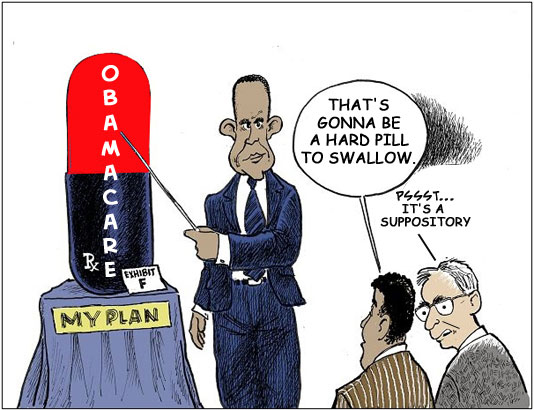
Sadly, "there is no plan," describes this country's collective response to this crisis. Despite all of the Obamacare wankery that the idiot Republicans shriek about as if it is the end of the world, the program hasn't even done what President Hopey-Changey promised it would: make health care affordable for all.

As the chart above from the article shows, health care debt is now the number one form of debt collected from Americans, trumping mortgages by an astounding ratio of 38-to-1. For that kind of cash, one would think that Americans would enjoy an immaculate level of medical care rather than be besotted with an Orwellian, broken system that works great for rich people and those lucky enough to have good insurance but is an absolute nightmare for everyone else:
Medical debt triggers more than 60% of bankruptcy filings in the U.S. According to a September Bankrate survey, 44% of consumers making less than $30,000 a year say they have more medical debt than emergency savings.
As I stated in my recent posts about my battle with cancer, I am one of those fortunate enough to have "good" health insurance. And yet, even for me the co-pay I have to make for every office visit or procedure has increased in the past decade from $10 to $30 dollars, which is just a TAD higher than the rate of inflation. Still not that big a deal for me, but for someone making less than $30,000 a year per the above citation, that's not an insubstantial amount of cash, especially if they have a chronic illness that requires frequent attention.

During my cancer battle, I have hit the so-called catastrophic limit of $5,000 for each of the past two years, meaning that only about $10,000 of the roughly $500,000 my care has cost to date has been out of pocket. Sounds good, right? But even if that person making less than $30,000 a year was fortunate enough to have the same level of coverage I do (unlikely), that still represents more than 16.7% of their yearly GROSS income. To make matters worse, according to the article the amount of out of pocket expenses patients will have to pay are expected to increase by about THREE TIMES the rate of inflation over the next ten years.

So why is this problem just continuing to get worse? I've written here before about the staggering pay received by health care CEOs, but what it really boils down to is that health care has been turned into a commodity in this country. But it's a commodity in which the "consumer" has no real choice when they need to purchase it. It's either buy the hideously overpriced product, or live with the pain and discomfort of their illness if not die from it.

To make matters worse, there is ZERO chance our hideously broken political system will address the issue. Republicans and Democrats will continue to scream back and forth about the non-solution of Obamacare, the debate over which will serve its purpose of being a gigantic distraction for the masses as the those who rake in the obscene profits off of their fellow citizens' sickness and misery laugh all the way to bank.


Bonus: "You cannot run...and you cannot hide...from the wreck we've made of our house...from the mess inside"


Wednesday, September 17, 2014

A Half Million Dollars Could Save Your Life


There's a really dumb old adage that goes something like, "a liberal is really just a conservative who's never been mugged." I'm going to flip that little bit of "logic" on it's head by saying, "a conservative is really just a liberal who has never faced a life-threatening accident or illness sans good health insurance."

One thing I've been quite thankful for during my battle with cancer is that I at least have good health insurance and didn't face the additional awful stress of worrying about being financially ruined by the disease. In fact, given how close run this thing was (and still is, frankly) that would likely have been the literal death of me. Though I've lost track of the precise amount, to date the total cost of my care the past two years has easily topped $500,000. One shot alone that accompanied each of my twelve chemotherapy treatments and is designed to help regenerate white blood cells cost $10,000 apiece (yeah, HOL-LEE SHIT is exactly what I thought, too). How many people do you know that have that kind of cash sitting around in their rainy day fund? Yeah, I don't know many either.

It happens so often these days that you hear of someone who has cancer for whom their friends and family have put together a big charity drive that we don't even think anymore about how stressful it must be for the patient. One of the best gags on the otherwise darkly brilliant teevee show, Breaking Bad, even has Walt laundering his drug money through a charitable website set up by his son.

Since I do have good health insurance, I make a point whenever I am discussing my disease with someone of mentioning this cost and how lucky I've been not to have been bankrupted by my ailment. It's my little way of trying to raise awareness of our totally broken health care system without being overbearing about it or starting an argument (though I do notice that as a cancer patient I get far more deference when raising controversial topics than I used to get before I got sick). Sadly, it seems to go way over most people's heads, though I did get one conservative coworker of mine to admit that MAYBE everyone ought to at least be entitled to catastrophic coverage (though who would determine exactly what constitutes a "catastrophic" condition he didn't say).

Had I not had the insurance, I would have faced two stark choices when I was diagnosed: pay up or die. And considering how unlikely my survival was at the start (pancreatic cancer has a five-year survival rate of less than 10%), I might well have chosen the latter to spare my wife from losing the entire nest egg we have built up over the last 20 years. Had we had children, the choices would have been even bleaker--them losing their father versus the loss of any chance that their parents could have helped provide for their future. Strictly on an actuarial basis, treating my cancer made no sense whatsoever.

So why is it exactly that real national health care was a non-starter from the get-go, and how exactly did we end up with an Obamacare abomination that has done little to alleviate the problem? Because, quite simply, there is virtually no empathy left in American politics these days. The vast majority of the people who vote in this country have divided themselves up into two tribes: one who couldn't give a shit about the less fortunate, and one who turns a total blind eye to any injustice just so long as it is being perpetrated by politicians who have a little "D" after their names when they appear on teevee.

But there is one little way that I take solace in all of this. Up until two years ago, I used to joke that being in such good health my whole adult life meant that my health insurance carrier was making out like a bandit on me. As it turned out, however, the joke was on them.


Bonus: "Every life comes with a death sentence"


Monday, September 15, 2014

Killing the Pain


I'll begin this post by making a confession--over the past year I have become what some people would consider a drug addict. What that means is that I take continual doses of Dilaudid--synthesized morphine--all day, every day. That is not to say I am doing anything illegal, as my dosages are well within the limits set by my prescription. However, because of what has been diagnosed as moderate-to-severe neuropathy in my fingers as especially my feet, a fun little aftereffect of the chemotherapy that helped save my life, I need the drug just to get through the day without screaming. Yes, I am aware that there are other drugs and methods for treating peripheral nerve damage. Problem is, none of them have as yet been able to do squat to relieve my constant pain and discomfort. Maybe medical marijuana would be right for me, except it will be a truly chilly day in Hades before Virginia ever deigns to legalize it and asshole Obama, fake liberal fuck that he is, is every bit as hard-hearted a drug warrior at the federal level as any of his Republican predecessors.

But I didn't come here today to whine and complain about my own ailments. I only wrote that last paragraph so that everyone will know where I am coming from with the rest of this, and that obviously I have every bit of empathy in the world for people who truly are in pain.

That said, do you know what the number one cause of "accidental" death in America is these days? Drug overdose. And the leading form of drug overdose is...drumroll please...prescription drugs. Sorry, Phillip Seymour Hoffman, but heroin doesn't even rate.

I'll throw another little fun fact at you from the article I just linked. Despite having the only 5% of the world's population, America consumes an astounding 83% of the world's prescription opioids. Even considering that half the world's population is living in subsistence level poverty with little or no access to decent health care, that is an astounding figure.

Clearly, lots of people in this country are in pain for whatever reason. And just as clearly, there are lots of people out there whose lives have become so desperate and hopeless that they manage to kill themselves while trying to kill the pain.

The latest scare tactic media campaign--and that's another area where America proudly leads the world, using fear of drug abuse to scare the shit out of the "straights" who vote--features teevee ads telling adults to secure their prescription medications lest their drug fiend children and grandchildren get ahold of them and promptly kill themselves. One of the ads I saw recently featured a middle-aged gent standing in front of his bathroom mirror, calmly taking his meds while his teenage daughter stared back at him in the reflection doing the same thing. Made me laugh, because this bozo would have had to be pretty out of it not to notice his pills are disappearing twice as quickly as they ought to be, and with the tighter controls on prescriptions these days he's gonna run out of that shit well before he can get a renewal.

Maybe, as is usually the case, good parenting is a better strategy than keeping a padlock on the ol' medicine cabinet. That's not to say there aren't teenagers out there abusing prescriptions drugs, most certainly there are, but just that there is no better way to get those same straights all fired up about an issue than telling them it's for the good of the children.

As is usually the case with any supposed "crisis" our media decides is worthy of its very short attention span, nobody ever pauses to ask WHY this has become a problem. Why are so many people killing themselves with painkillers? Why do some teenagers feel compelled to try and escape reality for a few precious moments through the abuse of them? Actually, I think I may know the answer to that last one--it comes straight from a quote from a retired DEA agent in the linked article:

“I’m better at picking out drug addicts than anyone you’ve every met,” Stutman told the crowd.

Still, he can’t spot opioid abusers. His prime example: Talk radio host Rush Limbaugh, who confessed to being an Oxycontin addict for years while hosting a nationally syndicated show every morning, and nobody knew. The same can happen to kids.

“They’ll get A’s in high school until they’re dead, or so close it doesn’t matter,” he said.

Do you suppose it might be the pressure to GET all those A's, knowing that if they don't a truly grim future working the counter at the local Panera franchise awaits them, or that even if they do manage to get the grades it'll mean admission to a college that'll saddle them with debt they won't be able to pay off until they are well past their parent's age that might have led little Jane/Johnny to seek the solace of all those painkillers? Perish the thought.

This all should come as no surprise to any thinking person. America is a sick society in so many ways, and it just continues to get sicker every day. It's in everything from our poisoned politics, to our poisoned media culture and right down to the poisoned "food" so many of us consume in massive quantities. All of it causes pain, either physical or psychological--and once you have the pain we'll give you even more poison to help kill it.

But hey, it's all good for the corporate bottom line. And that's all that REALLY matters, amirite?


Bonus: I wish it hadn't been my destiny

Saturday, September 22, 2012

Being Poor is Killing Off White Americans--Really


For those of you who think that the population "die off" that is expected to occur as the long era of fossil-fueled economic growth gives way to scarcity and permanent economic contraction lies many years in the future, I've got a surprise for you. It's already happening:
For generations of Americans, it was a given that children would live longer than their parents. But there is now mounting evidence that this enduring trend has reversed itself for the country’s least-educated whites, an increasingly troubled group whose life expectancy has fallen by four years since 1990.

Researchers have long documented that the most educated Americans were making the biggest gains in life expectancy, but now they say mortality data show that life spans for some of the least educated Americans are actually contracting. Four studies in recent years identified modest declines, but a new one that looks separately at Americans lacking a high school diploma found disturbingly sharp drops in life expectancy for whites in this group. Experts not involved in the new research said its findings were persuasive.

The reasons for the decline remain unclear, but researchers offered possible explanations, including a spike in prescription drug overdoses among young whites, higher rates of smoking among less educated white women, rising obesity, and a steady increase in the number of the least educated Americans who lack health insurance.

The steepest declines were for white women without a high school diploma, who lost five years of life between 1990 and 2008, said S. Jay Olshansky, a public health professor at the University of Illinois at Chicago and the lead investigator on the study, published last month in Health Affairs. By 2008, life expectancy for black women without a high school diploma had surpassed that of white women of the same education level, the study found.

White men lacking a high school diploma lost three years of life. Life expectancy for both blacks and Hispanics of the same education level rose, the data showed. But blacks over all do not live as long as whites, while Hispanics live longer than both whites and blacks.

“We’re used to looking at groups and complaining that their mortality rates haven’t improved fast enough, but to actually go backward is deeply troubling,” said John G. Haaga, head of the Population and Social Processes Branch of the National Institute on Aging, who was not involved in the new study.
Notably absent from the above analysis is that being poor in a hyper-materialistic society in which social services are substandard at best and public transportation depending on where you live is inadequate to non-existent, really sucks balls. Throw in the callus attitude so many Americans have towards the less fortunate and it is a wonder that they manage to live for as long as they do. But hey, the hard core Randians should be happy to hear this as it means that there are going to be fewer "parasites" around sucking down their precious "hard earned" tax dollars.

Also of note from the article, a little vindication for author Dmitri Orlov:
The five-year decline for white women rivals the catastrophic seven-year drop for Russian men in the years after the collapse of the Soviet Union, said Michael Marmot, director of the Institute of Health Equity in London.
And as if comparisons to the collapse of the Soviet Union were not bad enough:
The dropping life expectancies have helped weigh down the United States in international life expectancy rankings, particularly for women. In 2010, American women fell to 41st place, down from 14th place in 1985, in the United Nations rankings. Among developed countries, American women sank from the middle of the pack in 1970 to last place in 2010, according to the Human Mortality Database.
America: we're number 41 and nobody gives a damn...USA! USA! USA!


Bonus: "Born down in a dead man's town"

Thursday, June 28, 2012

Well, OF COURSE Obamacare was Upheld


Lots of clueless political observers, especially those who occupy the mainstream media, are furiously scratching their heads this morning wondering just how it could possibly be that Chief Justice John Roberts, he of the atrocious Citizens United decision, sided with the Supreme Court's "liberals" in upholding Obamacare when in fact the answer should be glaringly obvious to anyone who understands how America really works these days. Just like with Citizens United, this was a pro big business decision. Obamacare's hideous health insurance mandate will be a boon for the insurance companies that will do absolutely nothing to curtail the exploding costs of health care. And that is just the way the health care industry wants it. This is an industry after all, which now boasts the highest paid CEOs, higher than any on Wall Street, including one who pulled down an astounding $145,266,971 in compensation during 2010.

Here is Talking Points Memo with some more details of today's historic farcical decision:
The Supreme Court has ruled 5-4 that the Affordable Care Act meets constitutional muster and can be allowed to continue its slow process of transforming the nation’s health care system.

Thursday’s historic decision, authored by Chief Justice Roberts, was by no means fait accompli. Though the consensus among constitutional scholars has always been that the law’s insurance mandate did not exceed Congress’ Commerce Clause powers, its opponents erected a counterargument that quickly became an article of faith on the right. In the end, Roberts’ decision upheld the mandate as an exercise of Congress’ taxing power.

The outcome has been a matter of tense speculation, hope and anxiety both in Washington and around the country from the moment President Obama signed health care reform into law.

Complicating matters for the law’s supporters, the administration’s top legal advocate, Solicitor General Donald Verrilli, choked in oral arguments before the Supreme Court — out-litigated by the GOP’s star attorney Paul Clement.

And in the days leading up to the decision, a peculiar conventional wisdom took hold — in the media, and among political and judicial veterans — that the mandate, and possibly other key provisions, or the whole statute, would fall.

But during oral arguments, Roberts tipped his hand, and provided the Court a glimpse at his reasoning. And in siding with the Court’s liberal wing, he may have saved the entire law. In the dissenting opinion, justice Anthony Kennedy, writing on behalf of justices Samuel Alito, Clarence Thomas, and Antonin Scalia, held that “in our view, the entire Act before us is invalid in its entirety.”
In other words, Roberts signaled to the other scumbag conservatives on the court that he would be the one to "sell out" his supposed principles and give them cover to vote against the decision and make it look like the fix wasn't in all along. This was such a beautifully orchestrated bit of political theater that I almost feel like I should stand up and applaud.


Bonus: Might as well learn to live with Obamacare, as now it's the law

Monday, June 4, 2012

Central State Hospital (Georgia) to Lay Off 280 Workers


One of the few "bright" spots in the latest monthly jobs report was the supposed growth in health care industry employment. And yet, as I've posted here, there have been an awful lot of recent stories like this one from the Macon Telegraph:
Central State Hospital in Milledgeville expects to lay off as many as 280 employees in the next month as the hospital transfers out the last of its patients with developmental disabilities.

Tom Wilson, a spokesman for the state Department of Behavioral Health and Developmental Disabilities, said Friday the last 15 patients should be transferred to community care by June 30.

Central State Hospital will continue with a forensics unit that handles about 182 people with mental illness, and a nursing home that cares for about 138 patients, Wilson said.

The number of job losses could have been higher, but 80 employees at the historic state hospital left on their own in the last month as the number of patients declined, Wilson said.

“The number of employees has declined quite a bit in the past six months as we’ve been making this concerted effort, and the doctors and the nurses have gone to find other work,” Wilson said.

Central State Hospital’s total employment Friday was 1,439 workers, down from about 1,900 three years ago, said Kristie Swink, a spokeswoman with the Department of Behavioral Health and Developmental Disabilities. The layoffs represent about one-fifth of the remaining employees at the hospital.
Reading that last paragraph, I can't help but think that somebody's lying about the supposed boom in health care employment. Sadly, the article also included this little nugget:
Milledgeville Mayor Richard Bentley said the community is working hard to bring more jobs to the area. A public-private prison is about to expand, and the community has been looking at redevelopment efforts.

“We’ve lost upwards of 2,500, 3,000 jobs over the past three or four years, and we’re replacing them 100 or 200 jobs at a time,” Bentley said Friday.
I've also posted multiple stories here about prisons across the country shutting down due to state budget cuts. But I guess Mayor Richard Bentley prefers to bury his head in the sand when it comes to inconvenient facts.


Bonus: "Forty Miles from Atlanta, this is nowhere...going to Georgia"

Friday, May 11, 2012

Retired Couples Need $240,000 Just To Cover Health Care Costs


Here is a good companion story to the one I posted yesterday about how nearly half of all Americans have no retirement savings. The Consumerist has the details:
If you and your loved one are looking down the road toward living out your golden years together, be prepared to have a pile of cash stashed away to cover your medical bills.

Fidelity Investments has released its annual projection on health care costs for retirees and calculated that a couple retiring now will need $240,000 to get through their remaining decades. That's an increase from last year's projection of $230,000.

The bank had cut the number for the 2011 report, citing portions of the Affordable Care Act that should reduce seniors' out-of-pocket expenses for prescription drugs. But Fidelity says medical costs are still going up, thus the rebound from last year's unprecedented dip.

"As long as health care cost trends exceed personal income growth and economic growth, health care will still be a growing burden for the country as a whole and for individuals," says Sunit Patel, a senior vice president for benefits consulting at Fidelity.
Let's see, the average couple is going to need nearly a quarter of a million dollars to cover their health care costs in retirement, and yet half of all American adults have no retirement savings of any kind, let alone for health care.

This will not end well.


Bonus: From my You Tube channel, "Doctor, my eyes...Tell me what is wrong...Was I unwise to leave them open for so long?"

Monday, May 7, 2012

Arcadia Resources (Indiana) Experiences A Fast Collapse


Something ominous in going on in the health care industry. Even as some health care CEOs have become the highest compensated chief executives in the country, a lot of companies are undergoing layoffs. Arcadia Resources, in particular, went from rapid expansion to fast collapse in just a couple of years. Here is the Indianapolis Business Journal with the details:
A major lender to Arcadia Resources Inc. has moved to foreclose on the struggling Indianapolis-based business, which in turn agreed to cease operations.

Arcadia reported the foreclosure agreement with Dallas-based Comerica Bank, which Arcadia owed $11 million, in a Thursday filing to the Securities and Exchange Commission.

The closing represents the probable final fall for the once-promising health care company. Just two years ago, in May 2010, the company announced a huge expansion that it expected would add 930 jobs in Indiana by 2013.

But, according to the company’s last annual report, filed in June 2011, Arcadia administrative staff had fallen slightly in the previous year, to 229. Its field staff, most of whom are not in Indiana, had remained steady.

To help pare down debt, Arcadia completed the sale of its DailyMed pharmacy business in February to a subsidiary of Illinois-based Walgreen Co. But the $2 million in proceeds from the sale went entirely to satisfy a debt to one of DailyMed’s suppliers.
I have been predicting here on TDS that the health care industry is yet another financial bubble that will implode in the coming years. Perhaps we are right now seeing the first signs of that collapse.

Sunday, May 6, 2012

Nursing Home Operator In New York Laying Off 100


Medicare and Medicaid cutbacks were the reason for this mass layoff story. Here is a local New York television station with the details:
Central New York’s largest operator of nursing homes is cutting 100 jobs as part of a restructuring plan. Loretto says the move is necessary to ensure its future.

Most of the layoffs are at the management level, while others include clerical and financial positions and don’t involve those who work directly with the residents. The cuts are across the board and do not impact any isolated facility.

With 18 different locations in addition to specialized programs for the elderly, Loretto serves more than 6,000 Central New Yorkers and their families.

“Most of the families who go into our facilities on a day-to-day basis are going to see no difference whatsoever…really the positions affected are not resident-care oriented,” said Loretto Senior Vice President Steve Volza.

While Loretto leaders say no further cuts are planned right now, they are continuing to work with a health-management firm to improve their efficiency as they adjust to new financial difficulties. Those challenges are tied directly to Medicaid and Medicare reimbursements from the government.

“Today, our funding levels are at 2006 levels. While everything is moving forward, ours has moved back. The reason why is to move people out of institutions and into more community-based settings and we understand what that message is about and that's what this change is about,” Volza said.
The company says the layoffs won't hurt the quality of care at its facilities. Sorry, but I don't believe them. It's also worth notingthat even with cutbacks like this, the costs of Meidcare and Medicaid have still been exploding. So what will happen to these nursing homes when the cuts REALLY start to bite?


Bonus: Not the best video quality, but here is Bill Burr on getting old

Friday, May 4, 2012

Medtronic Cuts 220 Jobs In Mounds View (Minnesota)


Yet another mass layoff notice from the health care industry, as reported by Twin Cities.com:
Fridley-based Medtronic is eliminating about 220 jobs in its division for heart rhythm devices.

The business unit, which is headquartered in Mounds View, makes pacemakers and implantable cardiac defibrillators, which shock failing hearts back into rhythm.

Sales of the heart devices have been sluggish for years. In previous years, Medtronic also has announced job cuts during the month of May, shortly after the close of the company's fiscal year in late April.

"They have to keep right-sizing the business to reflect the future prospects," said Tim Nelson, an analyst with Nuveen Asset Management. "I think this was a lot of Minnesota-focused people. It came with a pretty significant reorganization in product development."

Medtronic employs about 8,000 people in Minnesota.

Kathleen Janasz, a company spokeswoman, would not comment on the types of jobs eliminated or the location of affected workers. The reductions are being accomplished through a combination of buyouts and layoffs, Janasz said, adding that those facing involuntary separation are being given benefits including severance pay.

"General managers are now leading the business," she said of a reorganization that's part of the downsizing. "We believe that this is the right model that will be supportive in bringing new products to market faster and being more efficient in doing so."
Yep, because firing workers ALWAYS results in greater production and efficiency. So what is the real reason behind this announcement?
Growth in the market has been hurt by a series of product recalls over the years and, most recently, a federal investigation into whether implantable defibrillators have been over-prescribed. The device systems can cost up to $30,000.

Nelson said the job cuts reflected the sluggish outlook for heart rhythm devices. "This is endemic of a very slow growing - in fact declining - market," the analyst said. "Even though the signs are that things may be stabilizing a bit, they're still down."
So, it was a crackdown on unnecessary medical procedures being performed in the name of higher corporate profits. At this point, I'm pretty much beyond being surprised by this kind of stuff.


Bonus: Get rhythm

Monday, April 30, 2012

The Type 2 Diabetes Epidemic Among Young People Is A Calamity Just Waiting To Happen


At first glance, this story that appeared on CBS News over the weekend seems to be yet another depressing reflection on just how few people seem to give a damn that their unhealthy lifestyles are not only slowly killing them but their children as well:
There is a growing epidemic among American children, and now there is a new recommendation on how hundreds of thousands of those kids should be treated.

The problem is type 2 diabetes, and it is a problem that is confounding more doctors, families, and health care professionals every day.

CBS News correspondent Tony Guida reports type 2 diabetes was never seen in young people as recently as 15 years ago. Now it's occurring with alarming frequency. Doctors know that a major risk factor is obesity. Beyond that, they were mostly in the dark about this disease.

"Very little is known about the right way to both prevent it and treat it," said Dr. Robin Goland.

A new study out today in the New England Journal of Medicine finds that the standard treatment for type 2 diabetes in children is ineffective because the commonly prescribed drug Metaformin - effective in adults - has a high failure rate in children. Still, a combination of two diabetes drugs is far more effective in treating young people.

"Two drugs right off the bat, that's an important finding," Goland said.

It is important because type 2 diabetes appears to be more aggressive in young people between the ages of 10 and 17, putting them at great risk for life-threatening illnesses typically associated with seniors.

"We want them to grow up and have healthy lives and not be having heart attacks and strokes at terribly young ages," Goland said.

When it comes to preventing type 2 diabetes, more exercise and a healthier diet are key, but doctors know young peoples' habits are tough to change.

"The first surprise that we saw was, number one, how incredibly difficult it was to effect lifestyle change in these children, in these youth that have type 2 diabetes," said Dr. Kenneth Copeland.
Well, of course it is going to be difficult to effect a lifestyle change in those children. If their parents aren't willing to MAKE them change their habits, its a hopeless cause. Right here I could get up on my soapbox about parental responsibilities and and our mindless teevee-dominated culture that has created a generation of fat, slovenly couch potatoes and blah, blah, blah. If you're looking for that kind of commentary, read Karl Denninger's take.

Instead, I'll boil my reaction down to one very simple observation: what in the hell is going to happen to these kids and their parents when our unsustainable health care system starts to break down within probably the next few years? Not to mention that when energy prices become prohibitively expensive, suddenly these wheezing, waddling fools won't be able to rely on their cars and all of the gadgets that make their lives so effort free. I don't think it takes too much imagination to realize that there are many millions of people who are going to be is deep trouble from a health standpoint long before the collapse finally comes.


Bonus: "I hope that you got fat...'cause if you got really, really fat, you might just want to see me come back"

Sunday, April 15, 2012

Crozer-Keystone Health System To Cut 325 Jobs In Delaware Valley


Here is yet another mass layoff story from the health care industry. Newsworks.org has the details:
The Crozer-Keystone Health System is laying off 325 workers from its five hospitals and one health network in the Delaware Valley.

Spokeswoman Kathy Scullin said the health system's bottom line is hurting from the shift from inpatient to outpatient treatments.

"Insurance companies who used to reimburse us for a three-day patient stay are now only reimbursing us for 18 hours, so we're losing thousands of dollars on these cases," Scullin said.
In the last 18 months, Scullin said, about 25 percent of traditional inpatient business has shifted to outpatient.

Scullin says the layoffs will be enacted proportionally throughout the health system's 7,000 employees.

So far, 150 employees have taken the early retirement packages offered to reduce forced layoffs.

Bill Cruice, from the union that represents nurses at Crozer-Chester Medical Center, said the reasons given by the hospital for the layoffs do not ring true to him.

"They made $8 million the first six months of the (fiscal) year," Cruice said. "So there doesn't seem to be a sync between the hospital making money and saying that they need to downsize."
Bill...Bill...Bill...how is the hospital ever going to attract a top CEO talent vulture if it actually has to pay its employees?


Bonus: There's no truth to the rumor that Crozer-Keystone employs Dr. Nick

Eight Old School Diseases Making A Comeback


The economic collapse is only just beginning, and already some infamous long thought defeated diseases are alarmingly starting to reappear. The reasons for the resurrection of these various scourges upon humanity vary, but the timing of their return is quite ominous. This helpful list comes to us via Mental Floss.com:
1. Scarlet Fever

This deadly disease was first described in the 1500s. Due to its contagious nature and debilitating, if not deadly, effects, outbreaks of scarlet fever were greatly feared. Fans of the Little House on the Prairie series will remember that it was scarlet fever that resulted in Mary’s blindness.

Penicillin proved an effective treatment for the disease, until last year. A sudden spike in scarlet fever cases in China and Macao, up almost threefold and fivefold from 2010, respectively, has alerted scientists to a new, more virulent form of the disease. It was not just Asia that reported more cases, with a sharp increase in incidents in Michigan last year.

2. Rickets

Rickets was most common in industrialized cities during the 1800s. Children who worked in factories had poor diets and got little sunlight, resulting in a Vitamin D deficiency. This can lead to bone problems, bowed legs, and stunted growth. Since it is such an easy disease to avoid simply by spending a few minutes in the sun each day, as child labor laws limited kids’ time trapped inside, rickets all but disappeared.

Since rickets had been perceived as a disease that was “taken care of” for almost a century, doctors in the US and Europe were astonished when it suddenly started showing up in increasing numbers of children in the last decade, with several hundred cases in England alone in 2009. Part of the problem is that many children are back to having poor diets and spending very little time outside. But the problems also present themselves in infants, ironically because new mothers are trying to do everything right. Breast milk does not contain Vitamin D and as more women breastfeed their children exclusively, and for longer time periods, as well as protecting their children’s sensitive skin from the sun when they go out, Vitamin D deficiencies are becoming more common in infants. Doctors urge women to keep breastfeeding, but to give babies vitamin supplements as well.

3. Gout

The first documented case of gout was in Egypt in 2600 BC. While anyone could get it, it was known as “the king’s disease” because symptoms most often presented themselves in royalty and the wealthy; Henry VIII and George IV were both sufferers. There was no cure, and once someone had one attack of gout they were likely to get it again. The main symptom was unbelievably excruciating pain in a joint, usually a toe. Attacks could last up to a week, made walking almost impossible, and even covering one’s self with a light blanket was usually too much pressure on the joint.

The number of people suffering from gout in the US has almost doubled since the early 1990s, with 4% of adults presenting symptoms in 2010, and the numbers are expected to keep rising, for two reasons. One, our diets are atrocious. Eating rich, fatty foods, and drinking alcohol add to your risk of getting a gout attack. Two, gout is much more prevalent in the elderly. 13% of Americans over 80 suffer from gout, an increase of 7% in the last 20 years alone, and as more people live to that age the number will most likely continue to increase.

4. Syphilis

This sexually transmitted disease first appeared in Italy in 1494. While no one is sure where it came from, the date and location have led many historians to conclude it came to Europe from the Americas. For over 400 years it was completely untreatable, and became an epidemic in some areas. Vincent van Gogh’s brother, Winston Churchill’s father, and Al Capone all died of syphilis, while everyone from Henry VIII to Oscar Wilde to Adolf Hitler are suspected cases.

The discovery of penicillin in 1943 as well as a greater awareness of the dangers of unprotected sex led to increasingly fewer people presenting symptoms of the disease. In 2000, public health officials announced that syphilis was almost completely eradicated in the US. But over the next decade the number of people testing positive more than doubled.

There are a few reasons for this. One is that more people are getting tested for STDs in general, so more cases are being caught. But doctors also say it is because of problems with sex education. Many people who test positive contracted the disease through oral sex, which they mistakenly believe is safe without protection. Also, since the disease was so close to being eradicated, many young people were not taught about it in school and are unaware of the symptoms to watch out for.

5-7. Measles/Mumps/Rubella

In the last 150 years, measles is estimated to have killed over 200 million people. Mumps was once the leading cause of viral meningitis. And rubella epidemics resulted in tens of thousands of miscarriages and deaths. Then in the 1960s, vaccines for all three of these diseases were developed. They were combined into one simple vaccine, the MMR, and the number of cases plummeted.

But in 1998, the prestigious medical journal The Lancet published a study that linked the MMR vaccine to autism. The results were widely reported, fueling the anti-vaccine movement, and large numbers of parents stopped vaccinating their children against these diseases. In 2004 and again in 2010 the article and its findings were officially rejected as “utterly false” by the medical community, but the damage had been done. Outbreaks of all three diseases are increasing.

In 2011, 25 states recorded cases of the measles, the most in a decade and a half. The disease is especially dangerous in populations that have had no exposure to it, as the US hasn’t for forty years, meaning incidents are expected to increase among the unvaccinated. Britain, France, Germany, the Netherlands, Norway, Romania, Russia and Switzerland all showed increasing numbers of cases in the past decade. In 2010 a mumps outbreak occurred in young, unvaccinated men in Ireland. A mumps outbreak at the University of Iowa lasted 6 months and spread to 13 states. And just last month, more than 20 mumps cases were diagnosed on the Berkeley campus. Doctors expect more outbreaks of these diseases, as the children who were not vaccinated in the immediate aftermath of the article start sharing dorms with each other.

8. Polio

While suspected cases of polio go as far back as Ancient Egypt, the first clinical description of the disease wasn’t written until 1789. While occasional individual cases were not uncommon, it wasn’t until the 20th century that a worldwide polio epidemic occurred, peaking in the 1950s. Franklin D. Roosevelt is probably the most famous sufferer, but at its peak polio paralyzed or killed half a million people every year. Then two different vaccines completely eradicated the disease in all but four countries.

Those countries—Afghanistan, Nigeria, India, and Pakistan—are all showing increased cases of the disease in the last decade. In 2003 leaders in northern Nigeria warned against getting vaccinated, claiming it could cause infertility. This resulted in the disease spreading into Chad, where it had previously been eradicated; 132 cases were reported there in 2011. Afghanistan reported an all-time low number of cases in 2010, but that number more than tripled in 2011, thanks to some people’s refusing to vaccinate their children on religious grounds, as well as the open border with Pakistan, who also saw their reported cases more than double in 2011. Some extremist Muslim leaders in that country have denounced vaccinations as a Western conspiracy.
Of all the diseases on the list, Gout would have to be the least worrisome. There are going to be a lot fewer people eating rich fatty foods and aggravating their joints in the near future. Rickets will probably cease to be as much of a problem when people begin having trouble finding shelter and are out in the sun a lot foraging for food.

As for the others, I can picture them reaching epidemic proportions not long after the medical system finally collapses. This list serves as another sobering reminder of how grim the post-collapse world is likely going to be for most people.


Bonus: Difficult to cure

Wednesday, March 28, 2012

10 Million Americans Lost Employer Sponsored Dental Benefits in 2010


I know we have an awful lot of Anglophiles living in the U.S., but this is ridiculous. Here is the San Francisco Chronicle with the details:
Employer sponsored dental benefit enrollment declined by 5.7% in 2010, according to the National Association of Dental Plans. It's the first drop in dental enrollment since 1994, the year NADP began tracking enrollment. The Value Dental Plan, which hopes to capitalize on the decline in employer sponsored dental insurance, is not traditional insurance but rather a program providing significant discounts to its members with over 50,000 participating dentists across the US.

The "2010 Dental Benefits Enrollment Report," issued by NADP and Delta Dental Plans Association, revealed that only 166 million Americans (54%) were covered by some form of dental benefit through group or individual plans in 2009.

The 5.7% dip reflects about 10 million fewer Americans with dental coverage, compared to 2008 figures. Still, enrollment from 2006 through 2008 increased in line with U.S. population growth, remaining steady at 57%, according to the research.

"While total enrollment significantly declined in 2010, the number of employer groups offering dental benefits remained consistent, compared to the previous year. Based on data submitted for the report and other industry studies by LIMRA and NADP," says Evelyn F. Ireland, executive director of NADP. The recession and a stalled economy contributed, in part, to decreased enrollment. "The reduction in subscribers in some employer groups in 2010 most likely reflects family financial constraints and layoffs.
Dental insurance for many has never been all that great. My own health care plan, which is quite good otherwise, only covers a very small percentage of my dental care. On the flip side, there doesn't seem to have been nearly the explosion in dental costs like there has been for other areas of health care. I had a crown put in last year that probably only cost about 20% more than one I had put in 15 years ago. There's a lesson there somewhere.


Bonus "Dental plan....Lisa needs braces...dental plan...Lisa needs braces"--The remix

Friday, March 23, 2012

Northwest Community Healthcare (Illinois) Lays Off 104 Workers


More bad news from the health care industry. Here is Crain's Chicago Business with the details:
Northwest Community Healthcare laid off 104 employees this week after the Arlington Heights-based system lost $13.2 million on operations in 2011, the third-straight year of losses.

The job cuts represent about 3 percent of the workforce, said Jackie Speckin, Northwest's director of strategic marketing, who confirmed the layoffs.

Employees were laid off on Monday and Tuesday, she said. Most of the jobs were eliminated at the 496-bed Northwest Community Hospital, where average occupancy fell to 67 percent during the fiscal year ended Sept. 30, from 70 percent during fiscal 2010.
Nothing terribly remarkable there, but check out this passage:
Ms. Speckin blamed the performance on industry trends.

“We're experiencing what every other hospital nationwide is experiencing, and that's a decrease in the amount of inpatient volume,” she said.
A decrease in inpatient volume, eh? Given that the population continues to both grow and the average age is gradually increasing with the graying of the Baby Boomers, why do you suppose that would be? More people losing their health insurance who can't afford hospital stays?

That would be my guess.


Bonus: In light of this story, here is a good sentiment from the late, great Warren Zevon...too bad he didn't manage to avoid it himself

Thursday, March 15, 2012

Study: Health Care Premiums Will Surpass Median U.S. Incomes By 2033


I've asserted here before on TDS that you really don't have to be an Ivy league educated intellectual to be able to spot all of the ominous trends in our society. Sometimes all it takes is a basic math skills and a little common sense. Last September 29th, I wrote a post called, "Cost of Family Health Care Coverage Doubled in the Past Decade," in which I cited a news story about rapidly rising health insurance premiums. Taking the figures from the story, I did a little math and made the following calculation:
Keep in mind that the median household income in America is somewhere around $49,000. So that means it costs nearly a third of a family's annual income to provide that family with adequate medical coverage. And the cost just continues to rapidly spike upwards despite the corporate giveaway known as Obamacare.

By my back-of-the-envelope calculation, at the same 9% rate of annual increase in health insurance costs seen during this past year, the total cost of the insurance would more than double again by the year 2020, to just over $32,000. Given that incomes remain stagnant, and are at best likely to continue to be so as the Great Recession drags on, that means the cost of a family's health insurance would then consume nearly two-thirds of their annual income before taxes.
A scary prediction, right? Well, now comes the confirmation that I wasn't all that far off in my assertions. As reported by the Raw Story, the Annals of Family Medice just published a report on this very same topic, and the statistics are grim:
The cost of health care will surpass the price of a median income household in the United States by 2033 if current trends continue, according to a study published in the March/April issue of Annals of Family Medicine.

Researchers accumulated data from the U.S. Census Bureau and the Medical Expenditure Panel Survey to compare Americans’ incomes and the premiums they’ve paid from 2000 to 2009. The cost of premiums rose by eight percent over that time period compared to just two percent of incomes.

If those trends continue, the average cost of a family premium will be half the income of a median household family, which was $49,800 in 2009, in 2021. Premium costs would exceed the median family’s income by 2033 if trends remain unchanged.
Once again, I take no satisfaction in being right when the implications are so dire. In my original blog post, I wrote the following in conclusion:
When a trend appears to be unsustainable, you can bet darn well that it is. At this staggering rate of increased costs, the American medical system is headed for collapse, and not in the distant future either. Unless something dramatically changes, I don't see how the system as currently constituted survives even the current decade.


Bonus: "I know the whiskey won't soothe my soul...and the morphine won't heal my heart"

Tuesday, March 13, 2012

Medicare Cracks Down On Power Wheelchair Claim Fraud


You can hardly leave the house these days without seeing someone riding around on one of those power wheelchairs. And if it seems like some of the people using them don't really need them and should be up and walking around, there might just be a very good reason for that. Here is the Tampa Bay Times with the story:
Whether covered by insurance or not, many Americans have power wheelchairs and scooters, as anyone visiting a supermarket or shopping mall can attest.

Now Medicare says it has been spending far too much on them, and Florida is one of the first states where the agency is cracking down.

In 2009, the most recent year for which figures were available, Medicare spent $723 million on power wheelchairs and scooters. And after a study, the agency estimated that at least 60 percent of claims were paid despite shoddy paperwork or were for devices that the recipient didn't need.
So just how bad is this form of Medicare fraud?
How much is Medicare losing? A review of power wheelchair claims for the first part of 2007 found that more than half of $189 million in claims were medically unnecessary or so poorly documented it was impossible to tell whether they were needed, resulting in $95 million in improper payments.
But beyond scammers trying to rip off there government, there is a larger problem here:
Dr. William Quillen, who directs the University of South Florida's school of physical therapy and rehabilitation science, agrees that some people really do need these devices.

"But there are also people you see at Target, Walmart or the mall (using power devices), and there doesn't appear to be any readily apparent medical need," he said.

But if you're capable of rehabilitation, the longer you spend in a power chair makes it more likely you'll never get out of it.

"They lose muscle strength and gain weight," said Kavita Jain, a therapy team leader at the Florida Hospital rehab unit. "We view it as equipment of last resort."

Etman said she thinks some doctors don't want to lose a patient by taking a tough stand, and so they sign the prescription.

"But they don't realize that it's hindering the patient, not helping them," she said.

Quillen said patients often ask about power chairs and scooters.

"Our first line of response is, 'let's not get down that road until we complete your rehab,' " he said. "We're not going to throw in the towel."

Staying active is especially important for people with chronic conditions such as diabetes, heart disease and obesity.

"It's kind of move it or lose it," said Dr. Richard Morrison, a Tampa heart surgeon. "We want them up and moving. If they stop that . . . (their) cardiovascular system isn't going to be in good shape."

Etman said she sometimes gets patients who have used a power chair for years.

"They hate us," she laughed. "We're trying to get them to where they can use a walker or a cane, or nothing, and they don't want to."
I really cannot fathom the mentality of a person who would rather be helplessly confined to a wheelchair rather than have the freedom to get up and walk around on their own. A few years ago, I suffered a total ACL tear and could not walk without crutches for about a month after the knee operation. Being essentially confined to my couch for all that time drove me absolutely stir crazy. I couldn't wait to get the physical therapy started so I could start moving around without assistance again.

The bottom line with this story is that you have several of the very worst traits of modern America all intertwined: corporate greed on the part of the companies that sell the chairs, an unaccountable big government program carelessly throwing taxpayer money away, and patients who have been conditioned to be lazy and helpless while expecting someone else to pick up the tab for their bloated medical expenses. It's upon reading stories like this one that you begin to realize just how traumatic collapse is eventually going to be for a very large percentage of the population.


Bonus: For anyone who doesn't realize that this band actually recorded more songs than just "Stuck in the Middle With You"

Friday, March 9, 2012

Walgreens Lays Off 123 In South Florida


Looks like Walgreens operations in the Sunshine State are taking a big hit. Here is the South Florida Business Journal with the details:
The Walgreen Co. warns it may lay off 123 workers in Miami Lakes, according to a state notice.

The Deerfield, Ill.-based company filed a Workers Adjustment and Retraining Notification (WARN) notice with the state of Florida on March 1, warning of mass layoffs from the closing of the central pharmacy operation portion of its Miami Lakes facility at 14901 N.W. 79th Court.

The layoffs are expected to take place around May 1 and the company expects the closure to be permanent, according to a letter to the state from Cassie Jesse, human resources manager. The letter did not address the reason for the pharmacy operation closure.

Positions being eliminated include group manager, central utility specialist, resolution center specialist and patient prescriber review operator.
Yet another blow for workers in the health care industry.


Bonus: "Mainline Florida, O.K."