Showing posts with label books. Show all posts

Saturday, August 18, 2012

Book Review: Zone One by Colson Whitehead (and a Site Announcement)

"To Kaitlyn, the scourge came from a different population. She aimed at the rabble who nibbled at the edge of her dream: the weak-willed smokers, dead beat dads and welfare cheats, single moms incessantly breeding, the flouters of speed laws and those who had only themselves to blame for their ridiculous credit card debt."

There is just something primal about a great zombie story. Maybe it's because zombies touch the deep fear many of us have of ever being singled out for destruction by a crowd of our fellow citizens, or maybe it's because zombies make the perfect metaphor for our brain dead, out-of-control consumer culture, but it is probably no accident in these paranoid times that the zombie has risen (so to speak) from B-movie status to become a very prominent icon in our popular culture.

That said, and take this as coming from someone who considers himself a bit of a zombie aficionado, most zombie novels (ahem) stink. They are often either self-published and atrociously edited and/or, the hero/protagonist is portrayed as some cartoonish action figure mowing down legions of the undead and ushering his little band of survivors to safety. Left unexplored in such books is a thoughtful examination of what it would be like to actually live in a world overrun with the undead. The one previous novel that explored such territory was Max Brooks's sublime World War Z, which stands as a towering monument among the vast wasteland that is zombie literature.

Well, now we can add a second entry to the list of great zombie novels. Colson Whitehead is probably the most talented writer to ever tackle the genre, and his writing style more resembles someone who produces short fiction for the New Yorker than someone who writes with too much testosterone and not enough (double ahem) brains. Zone One starts off kind of slowly, and much of the action takes place in a series of flashbacks, but it picks up steam and towards the end begins to deliver a series of strong stomach punches to the reader.

The story's protagonist, whose true name is never revealed but who goes by the ironic nickname of Mark Spitz, has been assigned as a sweeper, disposing of straggling numbers of the walking dead from lower Manhattan as part of a project by the newly reborn U.S. government to retake the island and once again make it suitable for habitation by the living. Mark Spitz and his fellow sweepers move methodically from building to building, ousting and dispatching the occasional animated corpse while dealing with their own tormented memories of the Last Night and everything they have lost and have witnessed since then. A constant theme of the novel is whether the survivors should let themselves hope that civilization can really be reborn, or whether they should remain within their hardened psychic shells (suffering from variations of a malady wryly named Post Apocalyptic Stress Disorder, or PASD) until the war against the undead has truly been won.

As all good zombie stories should, Zone One contains plenty of wry social commentary on the times in which we live, satirizing everything from the militarization of our society to the banality of reality television. The plot, despite the many detours through each main character's personal history, builds to a appropriate and logical climax. My one forewarning is that this is a literary zombie novel, and the style of writing may be a bit off-putting at first (this could also be why it has such a low average customer review rating on Amazon). Overall, Zone One is a very appropriate story that seems distinctively tailored to times in which we live.


Site announcement: I will be out of town starting tomorrow until after Labor Day (September 3rd). There will no posting and there may be long delays in moderating comments (depending on my Internet connectivity) during this time.

Bonus: "All we want to do is eat your brains"

Sunday, August 5, 2012

Book Review: The Last Policeman by Ben H. Winters

"So then, Doctor. What are our options?"

Dr. Leo Tolkin trembling, almost laughing. "Options? There are no options."

Despite all the official denial and obfuscation regarding the current collective predicament of mankind, the end of the world is a HOT topic in the popular culture right now. Maybe it's because many people feel the truth of the matter subconsciously even if they are not willing to admit it openly, but from The Walking Dead to Left Behind, there's a vision of the onrushing apocalypse out there to suit every taste and political and religious perspective. Much of it is pure garbage, which for me is why it is such a pleasure to stumble across the occasional gem amidst all the dross.

Ben H. Wniters's new novel, The Last Policeman, was written in the grand tradition of the Nevil Shute classic, On the Beach, of wondering what would life be like in a society that knows it is doomed and is merely waiting for the end to come. In Winters's novel, it is not the encroaching radiation from a nuclear war which looms over the eponymous protagonist and everyone around him, but an impending asteroid strike.

Now, I know what you are thinking about how overused this fictional scenario is, but The Last Policeman is no dumbass Armageddon movie. It is instead a very intense and realistic portrayal of a society that is already rapidly unravelling even as its doom remains more than six months in the future. In Winters's chillingly realistic vision, the economy is breaking down as many people either walk away from their jobs to pursue their bucket lists, descend into hopeless substance abuse or kill themselves out of despair. All the while, an increasingly authoritarian federal government is all that stands between America and mass chaos and starvation.

Enter Hank Palace, the last policeman of the title, who despite having served on the Concord, New Hampshire, force for less than two years has been recently promoted to detective because so many cops have already left the force. Arriving at the scene of yet another apparent suicide, Palace becomes convinced that the victim was in fact murdered and sets out to solve the crime, thus raising the question of whether solving a murder case still matters when everybody is going to die soon anyway.

The Last Policeman works effectively both as a murder mystery and as a portrayal of modern society undergoing collapse. Winters keeps his audience guessing--at first it is not entirely clear that Detective Palace isn't just tilting at windmills--and there are numerous unexpected twists and turns right up until the end. Particularly intriguing is how Winters portrays the actions of those who cling to an irrational hope that humanity can be saved and narrator Palace's disgust at both them as well as those who refuse to continue to do their jobs even in the face of utter doom.

If I have one quibble with the novel, it's that because it is the first in an intended trilogy, the narrative ends well short of the actual asteroid impact date. Nevertheless, Winters leaves things off in such a way that I am really looking forward to the publication of the next entry in the series. Overall, The Last Policeman is an enjoyable read that will stay with you after you have finished it, as all great doomsday stories should. It is definitely worthy of inclusion in any future version of my Top 10 End of the World Novels list.


Bonus: "If you are dying, why aren't you scared like I am scared?"

Sunday, March 18, 2012

My Top 10 End of The World Novels List Is Now On TopTenz.net


It has been a long time since I actually got paid to write something. A decade ago I was an aspiring mystery writer who actually had a contract with a small publisher for a private eye novel I wrote. During that period, I also managed to sell a short story to a dead tree mystery magazine (now long defunct) and had a short lived regular column about assassinations for the same magazine. When the publisher went out of business before my novel came out, I became frustrated and didn't take up writing as a hobby regularly again until I started this gig.

So I was quite pleased when the website TopTez.net picked up my submission of an article I did for them consolidating the End of the World novels list I posted here at TDS last June. And the best part is, they actually PAID me.

So in case you're interested some tips concerning quality apocalyptic fiction to pass the time while we wait for things to wind down in meat space, here's the link to the article:

Top 10 End of the World Novels

Enjoy!


Bonus: But of course

Monday, February 27, 2012

Mr. Paperback Bookstore Chain (Maine) To Close


I've covered the travails of the publishing and retail book industries here enough times that I really don't feel like rehashing it again. Here is the latest such sad news, from the Bangor Daily News:
Mr. Paperback, a bookstore chain that has been a fixture in Maine for 50 years, will be closing and its sister company, Magazines Inc., will be bought out, an owner of the companies said Friday.

Mr. Paperback’s 80 employees and Magazines Inc.’s 40 employees will be laid off, co-owner Penny Robichaud said. The companies notified their staffs on Wednesday.

“Business is not great. It seemed like it might be a good time to get out,” said Mr. Paperback General Manager Jim McCree. Both companies will cease operation by the end of April.

Mr. Paperback has 10 stores in Maine, with locations in Augusta, Bangor, Belfast, Caribou, Dover-Foxcroft, Ellsworth, Farmington, Presque Isle, Skowhegan and Waterville.

Magazines Inc., which distributes magazines and newspapers in the state, is based in Bangor.

Mr. Paperback and Magazines Inc. are separate companies, but are owned by the Foss family — Robichaud and her siblings Ralph Foss and Pamela Williams.

Robichaud said they are still in negotiations to sell Magazines Inc. to Hudson LLC., based in Worcester, Mass. The company would take over Magazines Inc.’s clients, and move distribution to a Gorham facility. Hudson LLC has no interest in taking over Mr. Paperback, she said, so the bookstores will be liquidated.

“We’re all just wrapping our heads around this this week,” said Robichaud.

“It’s painful,” said McCree. “Over the years we’ve had an extremely dedicated staff — smart people, faithful people. I can tell you it’s been extremely hard on the Foss family.”
A sad tale, indeed. But check out one of the reasons cited for the closures:
Robichaud said changes in the book industry and finances were the reasons for closing.

“It’s due to gas prices and a changing industry — Amazon, the Internet, Kindle — people don’t need the printed materials as much as we used to,” said Robichaud.

“Most of us know that the book business and anything in print is not a particularly healthy place to be,” McCree added.
There it is--gas prices. Sure there are strong headwinds in the industry from those other factors, but somehow I'll be that bookstores would not be shutting down with quite such rapidity if gas were still $1.30 a gallon. Call it a hunch.


Bonus: Terry Tate sez, "reading is fundamental." And you better listen to him, sucka

Wednesday, February 8, 2012

Christine O'Donnell Used Super PAC Money to Buy Copies of Her Own Book


Now here is a story guaranteed to make any thinking person's head hurt. Failed Delaware Senate candidate Christine "I am not a witch" O'Donnell, the most hilariously inept candidate for major office in recent memory (and that is saying a LOT), not only has her very own super PAC but has used it to buy copies of her own book. Here is Talking Points Memo with the details:
She may, famously, not be a witch, but here’s a bit of money magic from former Delaware Republican Senate candidate and recent Mitt Romney endorser Christine O’Donnell: her political campaign gave $142,000 to her super PAC, which proceeded to buy copies of her book.

Federal Election Commission reports filed by her campaign and super PAC this week show that the money her campaign gave to her super PAC represents just under 62 percent of the $229,985 the PAC took in during 2011. $19,912.30 of that money went towards an August 20th purchase labeled “PAC Fundraising Non-Residual Books” from a book shop in Philadelphia.

O’Donnell’s book, “Troublemaker,” had a list price of $25.99. If the books were purchased at that price, the campaign would have gotten around 766 copies. It’s unclear how all those copies were used for fundraising purposes since O’Donnell only received contributions from 16 individuals in the second half of the year. If all of them received a copy, she would have 750 copies of the book on hand.

Despite extensive media coverage of her book launch, “Troublemaker” failed to fly off the shelves, as Slate’s Dave Weigel pointed out back in August. The book only sold 2,000 copies in the first two weeks it was out. It’s unclear if the copies O’Donnell purchased counted during that period counted towards the total. But even if the super PAC only got a slight discount off the cover price, her super PAC would have purchased over half of the books sold in the first few weeks. If they bought them at the current Amazon price of $14.32, the PAC could have purchased 1,390 copies.
You'll recall that back when her hideous tome was released, O'Donnell managed to briefly reemerge into the headlines when she stormed off the set of an interview with CNN's Piers Morgan because the latter was asking her questions about witchcraft and sex. In my August 20th post of last year, "Why is CNN Still Interviewing Christine O’Donnell?" I questioned why CNN would give airtime to a such a total political loser. And given the completely lackluster sales figures from her book, that question is even more valid.

Some will also no doubt be outraged that O'Donnell can get away with using campaign funds to so transparently enrich herself. But that doesn't bother me as much as wondering just who it is that is so brain addled yet can still afford to donate over 200 Large to Christine O'Donnell the year AFTER she lost her Senate race by a landslide?


Bonus: "Hey little girl, you want it all. The furs, the diamonds, the paintings on the wall"

Friday, January 20, 2012

Book Store Blues


I've covered the rapid demise of America's brick-and-mortar bookstores several times here at TDS. Booksellers are now disappearing so fast that I wonder how long it will be before they vanish from the landscape altogether. It struck home for me again this past Sunday when, passing by my favorite Northern Virginia used bookstore, I was dismayed to see a big Going Out of Business banner hanging in the front window. I've been regular visitor to that particular store ever since it first opened in 1994, and most of the staff have worked there for many years. And now, just like that, poof--gone.

It shook me up enough that I decided to drive on over to the Barnes & Nobel location that is nearest to my house. I've never been a big fan of B&N because of how the chain drove so many mom-and-pop bookstores out of business, but other than the remaining used bookstores, they are about all that is left in Northern Virginia these days.

I hadn't been there in about six months, so I was very much relieved to see it was still open and actually had quite a few cars outside in the parking lot. When I went inside, however, there were changes afoot. Immediately inside the front door, right where the featured new releases used to be on display, was a brand new information booth where you could learn all about the Nook, and even take one of about a dozen display models for a test drive. Reacting as if a diamondback rattlesnake had just slithered into my path, I avoided eye contact with the two young salesgirls behind the counter and skirted around it as quickly as I could.

To my dismay, however, that wasn't the only change to the store. Literally about half of the space that used to contain books now no longer does. Instead, shelf after shelf was filled with toys and games and other useless crap that has absolutely nothing to do with actually reading. The non-fiction New Arrivals section had maybe a couple of dozen titles, whereas it used to occupy several bookcases and could take me a hour alone to browse through. The physical quality of the books that were present also appeared to have declined. The bindings these days are cheap, and even the hardbacks look they'll start to fall apart in just a few years.

Another distressing thing I noticed was just how shitty many of the titles were that were actually on the shelves. Celebrity biographies, teen vampire nonsense, self-help clap trap, romance novels and guides to spiritual living by teevee preachers seemed to be everywhere I looked, while serious works of either fiction or non fiction were in very short supply. Fittingly, in the bargain section there was one lonely copy of a cheapo hardback collection of reprinted classic short apocalyptic fiction stories that I almost bought just because of how perfectly apprpriate it looked sitting there on the shelf.

In the end, I merely grabbed a couple of deeply discounted titles because of how little there was that I actually wanted to read. The checkout clerk was a young guy probably not long out of college who was cheerful enough, considering, but when he asked me if I had a Barnes & Nobel membership card I had to restrain myself to keep from bursting out in a cynical cackle. No, I wanted say, but I'm good. I figure it's about a 50-50 chance at this point that your store will even still be here a year from now. Perhaps he knew what I was thinking, because when I merely said I did not have membership card, he didn't try to push one on me.

By the time I got home I was depressed. Despite what I write on this blog every day about America falling apart, I just can't imagine living in a world without bookstores. Sadly, that day is coming very soon. In fact, other than maybe making an occasional special trip to one of the two remaining independent booksellers down in the District of Columbia, visiting the bookstore has already almost become just a memory for me. It sucks.

Why are we as a culture in such a goddamned hurry to get rid of our physical books and replace them with these damn electronic readers? It's bad enough that the lingering effects of the recession were already killing the publishing industry.

You can't call it "progress," because that is complete and utter bullshit. We're maybe 20 years or so at best from the power grid breaking down on a widespread basis. So what happens to all those e-books then? They'll disappear into the ether, that's what. It's madness. But that's where we are as a culture these days.

Saturday, November 19, 2011

Last Bookstore in Delaware's Capital City Closes


Dover is the capital city of the state of Delaware and is about to become notable as a capital where there are essentially no remaining physical stores that sell newly published books:
DOVER, Del.- It's the end of an era for a popular bookstore chain in Delaware. Atlantic Books is going out of business after more than 30 years. The chain will close stores in Dover, Rehoboth and Bethany Beach.

Customers will now be left looking for other places to buy their books. Atlantic Books is the last major bookstore in Kent County.
To me this is a very sad story. I've been a book lover all my life. In my home I have custom built shelves weighed down with about 1,000 or so of my absolute favorites. I've never really enjoyed shopping as an activity, except that I can easily spend several hours in one sitting at a bookstore perusing the shelves.

The article continues:
Customer Theresa Stancliff said, "It's almost as if you like a real book in your hands, you're not allowed anymore without driving and making the sacrifice. It's very disappointing."

People like Theresa love the feeling of a real book in their hands. But, a tough economy and the rising popularity of e-readers have made it difficult for general brick and mortar bookstores to compete.
This is where I have to put on my peak oil writer's hat and say that you will not catch me dead with an e-reader, ever. I could say it's a sacrilege to read books that way, but that would make me sound like an old fuddy-duddy. Instead, I will make this argument: what's going to happen to all of those e-books in the coming powered down world of the future? Why, they're going to disappear into the electronic ether, that's what. To me, it's bad enough that someday I'm going to lose all of my music when the power goes out for good.

But at least I'll still have my books.


Bonus: Bill gets asked the question, "What you reading for?"

Thursday, October 27, 2011

Library Cutbacks Fall Hardest on the Working Poor


image: the old public library building in Freeport, Illinois, which was built in 1901 and closed in 2004 when it was replaced by a new facility

When I was a kid I spent a lot of time at the library. This was back during the 1970s, before video games, 500 satellite channels and personal computers came to occupy every spare moment of the average child’s free time. Back then, the public library in Freeport, Illinois, was housed in a stately old turn-of-the-20th century brick building with high ceilings and old fashioned light fixtures, and I always used to get a thrill just from walking through the front doors. The place had that unique, musty smell of old books, and the library staff was always friendly and helpful, especially to children. I could spend hours just going through the various shelves looking for something special to read, and I always took it for granted that everyone else felt the same way I did about the place.

Though I did not know this at the time, Freeport's old public library was one of those built around the country by funds donated by Gilded Age businessman and philanthropist Andrew Carneige. According to the Wikipedia entry about Carnegie, he believed in giving to the "industrious and ambitious; not those who need everything done for them, but those who, being most anxious and able to help themselves, deserve and will be benefited by help from others." All in all, 2,509 "Carnegie Libraries" were built in the United States between 1883 and 1929.

Years later after I had graduated from college and moved to the big city to start my career, I became prosperous enough to buy any book I wanted to read and sort of fell out of the habit of visiting the local library. This became even more true after the rise of the Internet, which meant I no longer needed to go there in order to access reference books and encyclopedias. Nowadays, I still have a library card, but on those rare occasions when I visit my local branch I am more likely to be donating books for one of its periodic fundraising sales rather than checking one out.

I’ve also noticed that despite the fact that Fairfax County, Virginia, where I now reside, is one of the wealthiest locales in the country on a per-capita income basis, library hours have been drastically cut back. Our local branch is now closed on Sundays, only open a half-day on Saturdays and on weekdays it is open for precisely eight hours each day on a varying schedule. Several times I have gone there and been surprised to find it closed during what would be considered normal business hours.

Most people that live in my county probably consider this to be nothing more than an inconvenience, if they think about it at all. They all have the latest laptops and iPhones, with a world of information constantly available at their fingertips, so what do they care? This could be why public library funding is one of the first things to get the axe whenever state and local governments are making budget cutbacks. Most local politicians come from the same economic class as I do, and undoubtedly view the library as an arcane public service that, like the post office, no longer has the value it once did.

Such myopic thinking at a time when our economy is undergoing a slow motion collapse is exactly how America came to be in its current predicament. The decision makers cutting library budgets do not stop for one minute to think about what life would be like for them if they could not afford that fancy laptop, iPhone, Kindle or regular high speed internet service. This very point was made in a recent Chicago Tribune article:
When Charles Mason was laid off from his job as a truck driver two years ago, he turned to the Chicago Public Library, scouring the Internet for a new driving job that could support his family better than his meager unemployment check.

Though back at work now, he almost daily visits the library, where his children study and his wife, who works as a clerk, can earn a paycheck.

"It's a lifeline," said Mason, 45, a Back of the Yards resident.

At a time when libraries have become a beacon for job-seekers like Mason, the city is proposing reduced hours and hundreds of staff layoffs to shore up its own budget.

The cuts come despite library visitors continuing to rise on a statewide and national level, though Chicago has seen a drop in visitors overall in recent years after library hours were cut.

Nationwide, there were 1.5 billion library visits in fiscal year 2008, the most recent year available. That's up from 1.28 billion in 2003 and 1.09 billion in 1998, according to studies by the Institute of Museum and Library Services and National Center for Education Statistics. Illinois followed the same trend with 77.6 million visitors in fiscal year 2008, up from 63.9 million in 2003 and 57.1 million in 1998, the studies showed.

Experts attribute the increases to patrons looking for jobs, belt-tighteners choosing to borrow books instead of buying them and libraries' growing digital collections.
It should be pretty obvious from those statistics that about the LAST service local governments should be cutting out are libraries. Not only are they a vital public service in a country when the median income is a mere $26,364 per year, but they also function as one of those few places where people can gather with members of their local community. And with brick-and-mortar book stores rapidly being consigned to the dustbin of history, they are one of the few remaining places where you can actually go and BROWSE through a shelf of books. What a concept.

Sadly, I expect that exactly the opposite will occur. Not only are libraries a tax “burden,” their support requires the kind of belief in the common good that has come to be in all too short supply these days. As the financial squeeze for state and local governments continues to get worse, libraries will likely be among the first municipal services to be terminated completely, for such shortsightedness and selfishness has become the norm in these waning days of the American empire. Andrew Carnegie, grandfather figure as he is to today's billionaires, is no doubt rolling over in his grave.

Tuesday, July 19, 2011

Borders Books Finally Succumbs to the Inevitable


Yesterday, Reuters reported that the Borders bookstore chain has succumbed to the inevitable and will now be liquidating its 400 remaining stores. Not incidentally, 10,700 employees will now be cast out into the worst jobs downturn since the Great Depression. No doubt, huge flocks of mindless consumer vultures will descend upon the remaining stores when the bankruptcy sales begin to pick over the carcass, just like they did during the first go-round of store closings last March.

Go on, you just GOTTA get that 30% discount on those Harry Potter and Twilight novels. Ignore the poor guy behind the counter ringing them up who will be facing financial destitution in just a few weeks. Consume, consume, consume and the consequences be damned. That’s the AMERICAN way.

While I feel bad for the employees, I will not particularly miss Borders the company. I’m an avid reader who owns over 1000 books, but only a very few of them were ever purchased there. Borders and its stronger competitor, Barnes & Nobel, were responsible for driving most of the independent booksellers around the country out of business during the past 30 years. And not because they had better prices either—they didn’t. I guess it must have been because they had larger and glitzier stores, for if there’s one thing American shopper zombies love almost as much as a sale, its glitz.

Here in the DC-area the big local retailer was Olsson’s Books, a homegrown chain that had a cadre of loyal employees, some of whom worked for the company for 20 years or more. They had great customer service, an actual sense of community and I always made sure to purchase my books there whenever I could. Fat lot of good it did for them in the end. After closing individual locations one by one starting in the middle of this past decade, the company finally went under completely just a couple of years ago.

Ironically, after helping to devour Olsson’s the predatory Borders was ultimately done in by an even bigger, leaner and meaner predator, Amazon.com. Amazon not only features the convenience of online shopping and cheaper prices, but best of all it has expertly wriggled around the law to avoid having to charge sales tax.

What’s not to like? Except for, you know, another empty storefront at the local mall and longer lines at the unemployment office. Oh, and an insolvent state government that is now raising your taxes in other areas to make up for what the scofflaw Amazon refuses to charge.

The question that never seems to get asked whenever a story like this appears is, what happens when Internet shopping has finally destroyed so many American jobs that hardly anyone can afford to buy what’s being offered online? That’s the endgame our economy is slowly sliding towards even without the rampaging economic effects of Peak Oil and resource depletion.

But hey, bargain hunters; don’t worry yourselves about all of that depressing stuff. As the Reuters article went on to report:
The liquidation is expected to start for some stores and facilities as soon as Friday, July 22, and will conclude by September, the company said.
So make sure you get there early on Friday, so you can force your way in line ahead of the other massed hordes and get the good stuff before its all gone. That’s the AMERICAN way.

Sunday, June 26, 2011

Hunter S. Thompson and America's "High Water Mark"


The following is an excerpt from the novel Fear and Loathing in Las Vegas by the Godfather of Gonzo Journalism, Hunter S. Thompson. The main theme of the book was the hippie generation of the 60s coming to grips with the so-called American Dream, as they understood it, dying right before their eyes in the age of Richard Nixon.

The book was written in 1971, as the Vietnam War was beginning to wind down, the Apollo Program was landing astronauts on the moon and American domestic oil production was reaching it's all time peak. A pivotal moment in our history, I think we can all agree.

Sadly, the drugs that helped fuel Thompson's best works led to him becoming an increasingly addled caricature of himself before he finally committed suicide in 2005. In his prime, however, he was also an absolutely brilliant writer, so I will stand aside and let him describe Peak America as only he could:

Strange memories on this nervous night in Las Vegas. Five years later? Six? It seems like a lifetime...San Francisco in the middle sixties was a very special time and place to be a part of...

History is hard to know, because of all the hired bullshit, but even without being sure of "history" it seems entirely reasonable to think that every now and then the energy of a whole generation comes to a head in a long fine flash, for reasons nobody really understands at the time--and which never explains in retrospect, what actually happened...

There was madness in any direction, at any hour. If not across the bay, then up the Golden Gate or down 101 to Los Altos or La Honda...You could strike sparks anywhere. There was a fantastic universal sense that whatever we were doing was right, that we were winning...

So now, less than five years later, you can go up a steep hill in Las Vegas and look West, and with the right kind of eyes you can almost SEE the high water mark--that place where the wave finally broke and rolled back.

Sunday, June 19, 2011

My Top Six Writing Influences


Since I started this blog, I’ve received a lot of comments from readers who say they really enjoy my writing style, which is quite gratifying because not only was I not an English major, I was actually an atrocious speller as a child and positively HATED being forced by my teachers to diagram sentences in class. As I grew older, I managed to improve my writing skills by becoming a voracious reader—and not even so much the classics, of which I will readily admit to not having read as many as I should.

Since this is Sunday and normally a quiet day on the news font, I thought I’d indulge myself a little bit and put together for those interested a little list of other writers who are my most important influences. These are literary artists who, despite writing non-fiction, use prose that grabs the reader by the scruff of the neck and demands their attention. The subject matter they write about varies considerably, but what really matters is HOW they tell the story.

So all of that said, let’s get on to the list:

Hunter S. Thompson – the fact that I’ve used the phrase Fear and Loathing in the title of a couple of my blog posts should be a clue that the good doctor is a strong influence on my writing. Because Thompson spent a long career twilight as a drug-addled caricature of himself before finally committing suicide in 2005, people tend to forget how great he was during his heyday. Fear and Loathing in Las Vegas is his signature work, the central theme of which is the death of the American Dream, a topic of obvious relevance to this blog. Just as good were many of his pieces of actual journalism produced in the late 1960s and early 1970s; from the fascinating book, Hell’s Angels, to his blisteringly insightful coverage of the 1972 presidential campaign in which the Godfather of Gonzo Journalism nailed Richard Nixon’s character better than any reporter ever did before the Watergate scandal broke wide open.

Joe Bageant – it is really a shame that the man who ought to be the pride of Winchester, Virginia, died of cancer earlier this year having produced only two books during his lifetime. Deer Hunting With Jesus and Rainbow Pie are simply MUST-reads for anyone who truly wants to understand what has gone wrong with modern America. Even as good as they are, Bageant was a rarity in that he actually did some of his best writing on his blog. From 2004 until his memorable last post in December 2010 (“America: Y Ur Peeps Be So Dum?”), no blogger out there produced such high quality prose on the ‘Net. RIP, Joe, we miss you dearly.

Mike Royko – The late columnist for three different Chicago newspapers is another guy who did much of his best work in a highly disposable medium. Royko literally cranked out thousands of first rate columns from the mid-1960s until his death in 1997. Invariably, Royko took the side of the little guy against whatever corporate or governmental forces were trying to trample him or her, and for his troubles became a permanent enemy of the Daley Machine. The collected anthologies of his columns are priceless treasures, and his one actual full length book, Boss—Richard J. Daley of Chicago, is considered one of THE best works ever written about municipal politics and corruption in America.

Bill Bryson – The author of the delightfully funny and massively successful A Walk in the Woods is a much different kind of chap than those above him on the list. Nevertheless, readers who have only experienced his lighter-hearted later works might be surprised that Bryson’s earlier stuff was actually quite biting. For me his best book is The Lost Continent, which recounts the first time he returned to the United States after 20 years of living in England and travelled around the country in an effort to get reacquainted with his roots. To say he wasn’t exactly charmed by what he saw is an understatement. His subsequent second return to America resulted in Woods—which is also a very insightful work but doesn’t pack quite as much of a visceral punch. What Bryson has always excelled at throughout his career is writing prose that reads as if he is sitting right next to you telling a story.

Tony Horwitz – Like Bryson, Horwitz was a long time expatriate American journalist who subsequently turned to travel writing. Also like Bryson, he returned to the United States after a long period abroad and hit upon a particular subject matter regarding his native land that struck a major chord with the reading public. His signature work, Confederates in the Attic, is an absolute masterpiece. Ostensibly about how the U.S. is still fighting the Civil War, the book digs deep into the American psyche in such a way that is witty, informative and unsparing. The half of the book in which Horwitz spends his time traipsing around Civil War battlefields with a nutty, dedicated Confederate re-enactor are worth the cover price alone. His other works, particularly the pre-Jamestown American history account, A Voyage Long and Strange, are also very entertaining and informative.

Jon Krakauer – I very much admire anyone who develops a great writing voice through experience rather than formal education. Krakauer was a mountaineer who started his literary career with the excellent Into the Wild, the story of a young college educated American who tosses away all of his earthly possessions before traipsing into the Alaskan wilderness and starving to death. He followed that up with the tremendous Into Thin Air, about the disastrous 1996 Everest expedition of which he was a part. But it is his next book, Under the Banner of Heaven, which shows what a gifted writer Krakauer really is. Moving beyond works of personal interest or experience, his searing expose of the Mormon Church is compellingly readable and thought provoking. Krakauer’s work may be controversial at times, but one thing it is definitely not is boring.

Monday, June 13, 2011

Top 10 Doomer Novels Number 1 - The Stand by Stephen King (1978, 1990)


How the World Ends: Superflu epidemic and then an epic clash of good versus evil among the survivors.

Scenario: In a sweeping tale, King describes the breakdown of civilization as the plague sweeps across America and then slowly builds up the suspense to the final confrontation.

Coolness Factor: This was King’s magnum opus, his best and most memorable novel and one he’s never managed to top. The 1990 version restores an incredible 500 pages deleted from the initial publication, and yet doesn’t seem bloated despite its length. The Stand has had arguably had the greatest cultural impact of any doomer novel.

Likelihood of Scenario Coming True: 3 out of 10 for the epidemic part, 0 out of 10 for the supernaturally tinged, post-apocalyptic confrontation.

Sunday, June 12, 2011

Top 10 Doomer Novels Number 2 - On the Beach by Nevil Shute (1957)


How the World Ends: Nuclear war destroys the Northern Hemisphere and the survivors in the Southern Hemisphere await the arrival of the radiation clouds that will ultimately spell their doom.

Scenario: How would you prepare to die? How would you live out your last months on Earth?

Coolness Factor: This is the dean of all classic nuclear war novels. The ending is perhaps THE all time best for end-of-the-world fiction. A timeless classic that is no less moving or powerful today than when it was written.

Likelihood of Scenario Coming True: 5 out of 10. As the world economy disintegrates, I put the chances of someone eventually touching off a nuke at 50-50.

Saturday, June 11, 2011

Top 10 Doomer Novels Number 3 - World War Z by Max Brooks (2006)


How the World Ends: Zombie outbreak, baby!

Scenario: In the wake of the world wide zombie war, the narrator travels from country to country interviewing the survivors.

Coolness Factor: Best. Zombie. Novel. Evah. Brooks’s globe-trotting faux oral history is simply brilliant, packed full of humor, action and social commentary—and soon to get a second life, so to speak, from being made into a major motion picture starring Brad Pitt. The "Battle of Yonkers" scene is the most bad ass living-versus-dead confrontation you'll ever read.

Likelihood of Scenario Coming True: 0 out of 10. Well, it IS a zombie outbreak, after all.

Friday, June 10, 2011

Top 10 Doomer Novels Number 4 - The Road by Cormac McCarthy (2006)


How the World Ends: Not specified, but probably nuclear war.

Scenario: A father and his young son follow the road trying to find a place where the landscape is not utterly barren and forlorn.

Coolness Factor: The most “respectable” doomer novel out there, likely because of McCarthy’s stature as an author and a prominent endorsement from Oprah Winfrey. This is the one doomer book most people have read if they have read any at all. Viggo Mortensen was PERFECT playing the father in the movie version.

Likelihood of Scenario Coming True: 5 out of 10. Just because the Cold War is over does not mean the threat of a nuclear conflagration has ended. In fact, it seems likely that the risk will greatly increase as the coming resource wars begin to flare up in earnest.

Thursday, June 9, 2011

Top 10 Doomer Novels Number 5 - Random Acts of Senseless Violence by Jack Womack (1993)


How the World Ends: Not really specified, but in America massive civil unrest and economic collapse swirl in the background and eventually envelopes the main characters.

Scenario: A 12-year-old girl begins writing in a diary just as the world begins to fly apart around her.

Coolness Factor: Lou Reed used to crab about the condition of New York City, but he never saw anything like this. Though the novel is not specifically about Peak Oil, the slow implosion of America described in its pages can easily be imagined to have been caused by it. The first person narrative is as gripping as it is harrowing and the ending is as dark as it is grittily realistic.

Likelihood of Scenario Coming True: 9 out of 10. I suspect that within another 10 years this visionary novel will read like a documentary.

Wednesday, June 8, 2011

Top 10 Doomer Novels Number 6 - Sleepless by Charlie Huston (2010)


How the World Ends: An epidemic of insomnia is slowly consuming humanity.

Scenario: A dedicated undercover cop and an ice cold, aging hitman barrel towards confrontation in a slowly imploding Los Angeles during the year 2010.

Coolness Factor: Sleepless, as the mysterious disease is called, is actually a metaphorical stand-in for the onrushing effects of Peak Oil and resource depletion. Sleepless, the novel, is an action packed thrill ride with plenty to say about the likely near term future of humanity.

Likelihood of Scenario Coming True: 10 out of 10. It’s not that an epidemic of insomnia in imminent or even a realistic possibility—it is rather that author Charlie Huston’s vision of the near term future as society breaks down is realistically scary and plausible.

Tuesday, June 7, 2011

Top 10 Doomer Novels Number 7 - Summer of the Apocalypse by James Van Pelt (2006)


How the World Ends: Pandemic kills off most of humanity, and then leaking radiation from abandoned nuclear power plants begins to finish the job.

Scenario: A story told in two parts, the protagonist is a teenager when the epidemic hits and an old man in a small community of survivors as it reaches its climax.

Coolness Factor: The author effortlessly weaves the two ends of the story together throughout the book. Plenty of action combines with moments of quiet philosophical rumination and an emotionally charged ending.

Likelihood of Scenario Coming True: 10 out of 10. I give this one a perfect score for recognizing five years before the Fukushima catastrophe that the world’s nuclear power plants represent a dire long term threat to humanity’s survival.

Monday, June 6, 2011

Top 10 Doomer Novels Number 8 - I am Legend by Richard Matheson (1954)


How the World Ends: An epidemic of rampaging vampirism.

Scenario: The last man alive is under siege in Los Angeles and is barricaded in his house every night, venturing out only during the day to forage and kill vampires in their sleep.

Coolness Factor: Hollywood absolutely loves this story, having essentially made it into three major motion pictures starring Vincent Price, Charleston Heston and most recently and regrettably, Will Smith. The book is far superior to all three, especially the ending, which twists the reader’s perception of who really is the monster.

Likelihood of Scenario Coming True: 0 out of 10. To the disappointment of millions of Twilight fans everywhere, there is no such thing as vampires.

Sunday, June 5, 2011

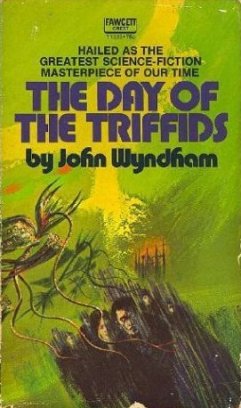
Top 10 Doomer Novels Number 9 – The Day of the Triffids by John Wyndham (1951)


How the World Ends: Mysterious comet passes Earth, leaving nearly all of humanity blinded in its wake.

Scenario: One survivor who retains his sight battles for survival in a world rapidly being overrun with mobile man-eating plants called Triffids.

Coolness Factor: The opening sequence in which the protagonist wakes up in a deserted hospital was chilling reproduced in the movie 28 Days Later and the teevee series, The Walking Dead. British sci-fi at its best--who would have thought that a bunch of plants could be so bad ass.

Likelihood of Scenario Coming True: 0 out of 10. Since there is no such thing as Triffids, I think we can sleep soundly knowing this book, while a great read, is not a prophecy of our collective fate.