Showing posts with label municipal governments. Show all posts

Tuesday, September 18, 2012

The Chicago Teachers are Fighting a Battle They Can’t Possibly Win


Let’s cut through all of the bullshit and get down to the brass tacks of what the Chicago teachers’ strike is really all about: a desperate, last ditch effort on the part of one group of public sector employees to prevent the inevitable downward slide that will cause them to slip out of the middle class for good. The petty details matter little in the big picture. The teachers are in a literal fight for their livelihoods and it is a fight they are eventually going to lose, if not this time around then at some point in the near future.

I’ve recently been reading the excellent book, Staying Alive: the 1970s and the Last Days of the Working Class, which recounts among other things the last great wave of labor unrest in America that occurred during the first half of that decade, when a new generation of union insurgents battled both corporate management and the ossified, complacent bosses of their own unions in an effort to revitalize, expand and strengthen the labor movement. For a brief, shining moment it appeared that they might be successful in those struggles, and then the economic malaise resulting from the 1973 and 1979 oil shocks combined with the first wage and job destroying effects of globalization to subvert and undermine what they accomplished. Shortly thereafter shrewd conservative charlatans like Ronald Reagan learned how to get workers to vote against their own economic interests by pandering to superficial patriotism and cultural prejudices. Reagan and his ilk were, of course, greatly assisted in those efforts by a liberal movement and a Democratic Party that abandoned the working class in favor of divisive identity politics and political correctness.

Flash forward to 2012, and what we are seeing now in the Chicago teachers’ strike is the last gasps of a labor movement that is all but completely dead in America. The power of unions in the private sector has already been mostly neutered by thirty years of piss poor and corrupt "leadership" combined with relentless corporate assaults and by “free” trade pushing politicians of both parties. While all that was going on, the public sector unions stood idly by while their private sector brethren’s livelihoods were slowly being stolen from them. And now that all those earlier battles have been lost, there is no one left to stand by the side of the teachers in their hour of need. In fact, judging by the vitriol being heaped upon the “greedy” teachers by their fellow laborers in internet forums and chat rooms, I’d say that the powers that be have been quite successful in their relentless campaign to turn all of us proles against one another so we don’t ever recognize who the true enemy is and unite against them.

The most telling sign I saw indicating that the teachers are doomed was when snot-nosed little punk Paul Ryan issued a statement of support for the heinous Chicago Mayor and Obama confidant Rahm Emmanuel. I’ve said it repeatedly on this blog, but in bears saying yet again: however much they may make a show of viciously fighting against one another, it’s when the two parties agree on a particular issue that you really need to grab hold of your wallet. If the teachers and other working and middle class citizens of this country had at least one of the major parties fighting on their behalf, they might stand half-a-chance of preventing their eventual impoverishment and destitution, or at least they could ensure that the selfish rich assholes who run the country share the sacrifice as the long era of economic growth draws to a close. But they don’t, and what’s worse most of them don’t even realize that they have in fact been completely abandoned by both major parties.


Bonus: I just had to post this clip since the irony of douchebag conservative economist extraordinaire Ben Stein portraying a Chicago area public school teacher giving a lesson about the Laffer Curve is just too delicious.

Wednesday, July 25, 2012

Miami Will Wallow in Shit After Horrible Baseball Stadium Deal

image: just that hideous abomination pictured above alone cost the taxpayers of Miami a cool $3 million.
Back on December 4th in my post, "SEC Investigating Dirty Baseball Stadium Deal in Miami," I highlighted a story of how officials of Miami-Dade County got fleeced by the ownership of the Miami Marlins, and may have been bribed to get them to approve a new taxpayer funded stadium:
The Marlins pushed the limits on exactly how much a team can hold its city hostage. They cried poverty and threatened to move unless they got a new stadium while refusing to disclose their financial records – records that were later leaked and showed a team swimming in tens of millions of dollars in profits and funneled millions more to a corporation run by team owner Jeffrey Loria.

Miami-Dade County commissioners nevertheless voted 9-4 in favor of taking out loans that will cost the county $2.4 billion over 40 years to help build the stadium in Little Havana, about two miles west of the city. Critics across south Florida panned the deal, which gives the Marlins all stadium-related revenue and imbued the team with a new attitude entering this offseason.
That story was bad enough, but now comes word that while the Miami-Dade County commissioners were showering taxpayer money on scumbag billionaire Marlins owner Jeffrey Loria, a dire crisis was building up elsewhere in the county. From the Miami Herald:
Miami-Dade County’s three main water treatment plants and nearly 14,000 miles of pipelines are so outdated it would take more than $1.1 billion just to replace the “most deteriorated, vulnerable sections” of the system, a newly released internal study shows.

Corrosion is so pervasive in the county’s water and sewage-treatment plants, and pipes that move water and sewage, that initial repairs could take from three to eight years, the five-month study found.

Each day 300 million gallons of waste and 459 million gallons of drinking water pass through the county’s system — the 10th largest water-and-sewer utility in the nation.

“The infrastructure we have out there is aged,” said John Renfrow, director of the water and sewer department. “Many of the pipes with leaks out there were built at the same time. It reminds me of an apartment where all the lights are put in at the same time, and you know how all the lights go out at the same time.”

Federal regulators told the county two months ago that it must perform repairs and upgrades. The U.S. Environmental Protection Agency and Department of Justice, along with the state Department of Environmental Protection, are expected to take another four months discussing with Miami-Dade how to fix and pay for a system that Renfrow said is “being held together by chewing gum.”

The study, requested by Commissioner Barbara Jordan, shows the majority of the initial fixes — about $736 million of immediate work — is needed for sewer lines. Water lines would take another $364 million to repair.

The county’s main water treatment in Hialeah, and two sewage plants, on Virginia Key and in South Miami-Dade, are 56, 45 and 87 years old, respectively.

Fixing wire and concrete erosion in pipes would cost about $10 million, and fixing water mains, tanks and pumps would cost another $129.4 million, the study estimated.
Not to put too fine a point on it, but obviously Miami-Dade County had better things to do with its money than build a fucking baseball stadium.

But hey, I guess at least the citizens of Miami now have a great baseball team to cheer for while they hold their noses because of all their stopped up toilets, right? Wrong, Natch. Here's Yahoo Sports with that tale of woe:
Here is how the con worked.

The Florida Marlins owners whined, and they brayed, and they swore up and down that they couldn't afford the new stadium necessary to raise their payroll from embarrassing levels and compete annually. And they got it, the vast majority on the taxpayer's teat no less, this gleaming new gem from which they would fatten their pockets by taking all of the ticket and concession and parking and advertising sales, every last cent, no matter how unseemly that felt.

To allay fears, they changed their name to the Miami Marlins, their colors to a rainbow vomiting, their image to reflect the city, hot enough that the New Yorker would profile them and Showtime would broadcast a documentary on them and free agents Jose Reyes and Mark Buehrle and Heath Bell would take the money. People actually bought into the thing, recognized them as a real team and not just some affiliate run by a couple of swindlers who had already screwed Montreal and were primed to do the same to another city.

It wasn't ever going to end any other way. You knew that. You knew. When Jeffrey Loria and David Samson are involved, it can't end any other way, because they know no different. Loria is the owner of the Marlins, Samson the president, and they're turning the Miami Marlins into a chop shop. Anibal Sanchez and Omar Infante were traded first this week, to the Tigers. Then Hanley Ramirez, who until this year Loria regarded as the franchise, to the Dodgers. Next could be Josh Johnson, their homegrown ace.

That would be $32.75 million shed within a week, bringing the Marlins from their $100 million dream back to the bottom quarter of payrolls in baseball.

And Miami is stuck with $2.4 billion in stadium debt service for that.

This would be falling-down funny if it weren't so very sad. Two charlatans, ripping off a major American city and laughing all the way to the bank.
In other words, the Marlins are still a shitty baseball team that is once again dumping its star players via trades in order to save money.

So how long do you suppose it will be before we start hearing rumblings about Miami-Dade County possibly having to declare bankruptcy because it can no longer afford to maintain its basic services? Meanwhile, instead of occupying a prison cell as they should, scumbag Marlins owner Jeffrey Loria and Team President David Sampson will be sitting pretty in the owner's box of the cushy new baseball stadium they built with money kindly donated by the taxpayers of a community that no longer can even afford working toilets.

God bless America.


Bonus: "Aw, Shit Man"

Monday, July 9, 2012

The Third World Comes to Scranton, Pennsylvania


The recent story about the salaries of municipal employees in the cash-strapped city of Scranton, Pennsylvania, being slashed to minimum wage has caused quite a stir in certain circle of the Internet. From what I’ve read on various websites, there were a lot of different reactions to this development, most of them based on either partisan politics or ideology. Predictably, liberals and progressives were bemoaning yet another assault on middle class wages and calling for massive tax hikes on the one percent to close the gigantic budget imbalances being experienced by states and municipalities all across the country. On the flip side were the conservatives and the libertarians, crowing that the “fat cat” government workers, and more importantly those evil public employee unions, were finally getting their comeuppance and being subjected to the “market forces” from which they had heretofore so impertinently felt themselves completely immune.

To both points of view I can only shake my head and say: yadda, yadda, yadda, whatever.

It’s amazing how few people seem to understand the real significance of this story. Is there a coordinated effort on the part of libertarian billionaires like the Koch brothers to smash the public employee unions and thus breach the last real bastion of stable middle class employment left in America? Undoubtedly. Do public employees and their unions have a completely unrealistic expectation of what pay and benefits are “owed” to them at a time when real economic growth is coming to an end and we are entering the age of contraction? Absolutely. But in the end, I would argue that those are relatively minor concerns for most people.

I think much of the comprehension problem starts with the insular lives most Americans lead. This is really not so surprising in a country where only about one-fifth of the population holds a passport, and even the overwhelming majority of those who do have them have never travelled anywhere more exotic than Canada, Europe or some Caribbean resort. So allow me as one who has actually visited the third world to enlighten the Nativists regarding one basic fact that they are failing to consider: you do not in any, way, shape or form want to live in country where the government employees, especially those at the state and municipal level with whom you have to interact on a regular basis to obtain many of your basic services, are not being paid a living wage.

Imagine for a moment residing in a place where the police do not more or less keep the peace, which they currently do in the United States despite the occasional abuse of power, but are in fact another armed gang roving the streets, extorting money not just from the bad guys but from honest citizens, either dealing drugs themselves or protecting the drug dealers and making perceived troublemakers permanently disappear. Imagine living in a place where you have to pay a bribe for every service, from getting your water turned on, to getting your garbage collected, to obtaining a driver’s license, to getting the police to respond to a burglary of your home, to getting that gigantic pothole in the street in front of your house fixed, to obtaining a birth certificate for your newborn child. Imagine living in a place where every favor, including your ability to obtain and hold down a job, is doled out in exchange for your vote by unaccountable political bosses who are little better than gangsters themselves and who have thugs on the payroll to make sure everyone in the neighborhood toes the line. This may sound like the stuff of a dystopian science fiction novel, but it is in fact the grim reality faced by probably a majority of the world’s population every day of their lives.

It was also typical of what residents of America’s larger cities faced back in the late 19th and early 20th centuries, when there was no social safety net and political machines like Tammany Hall used patronage and favoritism to rule most city halls with an iron fist. Over the course of time many reforms were enacted that eventually crushed the power of the machines and stamped out the routine petty corruption that touched the lives of nearly every citizen, but perhaps the most important factor was the professionalization of government employment and the lifting of wages for municipal employees to the point where, say, taking small bribes from citizens in exchange for approving permits was no longer worth the risk of losing their jobs. If you think dealing with the DMV is bad now, just wait until the employees there are all toiling for minimum wage.

Once again, if you have read this blog with any regularity you know that I am not advocating that government workers be allowed to maintain their pay and benefits at a time when their private sector brethren are losing theirs. In fact, the recent failed Wisconsin recall election vote shows how easy it has become for billionaire elites to turn the resentments of one sector of workers against another and get them at each other’s throats. Personally, I am first and foremost a believer in the idea of SHARED sacrifice in this era of permanently declining available resources, even though I know there is no chance that such a concept will ever be adopted in this country as long as those same billionaires can engage in unrestricted political war against the very idea. All I’m saying is that those who might be tempted to dance in the streets in celebration of what is happening in Scranton, Pennsylvania, and will likely soon be happening in many localities, should not complain when in a few years they find themselves living in the crumbling and thoroughly corrupt hell that will constitute Third World America.


Bonus: Close enough for government work

Tuesday, June 12, 2012

Computer Crash Cripples Jefferson County (Alabama)


So what does a large municipal bankruptcy really mean? Chaos. Here is al.com with the details:
A server that runs Jefferson County's financial software system has crashed and halted financial activity in a number of county departments, officials said Thursday.

Since Tuesday, the hardware problem has slowed or stopped transactions in the finance, treasurer and purchasing departments, preventing vendor payments and deposits and delaying preparation of the fiscal 2011 audit, according to county officials.

The server runs SAP, the accounting software system the county uses to track financial activity.

"The SAP functionality is so diminished that it does not allow us to do the day-to-day financial operations of our county," Commissioner Jimmie Stephens said. "It's the financial backbone of the county. It's the language that we use to communicate with all of our vendors and all of our financial contacts throughout the county. And to have it go mute to where we can't communicate is a tremendous problem."

County Manager Tony Petelos said all of the servers that run the SAP program have outlived their useful life, and of the 16 servers in the Information Technology Department, only one has any life left.

"The rest of them are outdated and they need to be replaced," Petelos said. "When one server crashes it causes the whole system to go down. I've said this over and over again: The county has to reinvest in its infrastructure, and this is only one key example."

Workers were able to restore the server but are looking for a way to load SAP programs and data, Petelos said. "If successful, SAP should be available within 24 hours," he said. "If unsuccessful, a complete rebuild of the system will be required and could take up to five days."

Stephens blamed the problem on staff reductions and decisions to reduce maintenance contracts to save money.

The cash-strapped county laid off hundreds of workers last year to conserve cash until a fix could be found for a shortage of general fund revenue. Wayne Cree, director of information technology, has said his department lost approximately 30 budgeted positions in the past year because of layoffs, retirements, transfers and resignations.
But here is the "money quote," so to speak:
Stephens said contracts countywide have been either terminated or reduced to save money, and the toll is mounting.

"You do away with people and you do away with outside maintenance contracts that take care of that proprietary equipment, and you're left with the inability to operate government," Stephens said.
Consider this an early warning of things to come all across the country.


Bonus: "Alabama...you've got a weight on your shoulders that's breaking your back"

Friday, June 8, 2012

Spoiled Rotten Nation: Infrastructure Must Be Paid for Somehow


Every once in awhile, a news story comes along that perfectly illustrates the concept of what I call, Spoiled Rotten Nation: people want government services, but they don't want to pay for them. Here is a Las Vegas television station with the story of citizen outrage at having been asked to pay for the services they actually use:
Clark County Commissioners got an earful today from people who got huge water bills in May thanks to fees meant to pay huge bills for the Southern Nevada Water Authority.

At the emotional meeting, non-profit groups, small business owners and residents said they can't afford new fees for services they once got for free.

Homeowner Mary Jo Aldeman said, "I feel as though we're being raped."

Commissioners, sitting as the water district board, claim the public was informed about the new fees approved in February. But, it was clear from the impassioned outpouring that while most were aware of the five dollar hike for residential customers, many were not aware of new fees for fire lines and fire meters until they got new, huge bills.

Brian Aldeman, with the Las Vegas Chamber of Commerce said, "You're seeing a bill go from zero to 660 dollars if you have a 10 inch fire meter. That's a tremendous impact"

Small business owner Leslie Dunn said, "This new business that we're opening up? We've already had to cut one new position simply because of charge. This added four hundred and something dollars to the bill."

Matt Frady of Girl Scouts of Southern Nevada told the commission, "We have projected that our costs for these first three years will be 300 percent of our current water bills."

Water authority head Pat Mulroy said she understands the sticker shock, but the agency is stuck too.

According to Mulroy, "This isn't an extraordinary charge.Cities across the country charge for fire lines. They have to. It's too much of an infrastructure burden"

Fire lines and fire meters used to be covered by connection fees. Those fees disappeared when the economy tanked.
But small business owners and non-profits say, their businesses will tank, and some residents fear they'll lose their homes, if they're forced to pay the water authority's $3-point-3 billion dollar bill for infrastructure costs, including a third intake pipe at Lake Mead.
To all those who are upset about receiving these bills, you really have a simple choice: pay them or stop receiving municipal water. Good luck with drilling a deep enough well out in the middle of the desert.

Providing you with the water costs a lot of money, and who else would you recommend pay on your behalf? You should actually feel grateful that it is your local government providing you the water at cost rather than some private corporation at a profit, because then I guarantee your bills would be a LOT higher than they already are.


Bonus: "There ain't no water here to be found"

Tuesday, June 5, 2012

Why Are Pension Plans On The Ropes? It's The Math, Stupid


An article appeared on Saturday about yet another municipal government out in California struggling with exploding pension costs. In both the public and private sectors, pensions have become a gigantic financial anchor, dragging down balance sheets. How did all of this come about? Many libertarian types will say that its because workers have "unrealistic" expectations about what is "owed" to them in retirement. That argument, however, is just typical callous Randian nonsense. The real reason why pension plans are in trouble is because of unrealistic expectations not on the part of retirees but by the supposed financial geniuses who run the pension plans.

It all really comes down to a lack of understanding of basic math, particularly exponents, and the simple fact that exponential growth in a finite world is simply not possible. Let me show you what I mean. Here is a brief excerpt from the Yahoo News article about the woes of the California pension system:
Meanwhile, the giant California Public Employees' Retirement System (CalPERS), the largest public pension fund in the country, has been engaged in a tortured debate about whether its rate-of-return assumptions are too optimistic.

The CalPERS plan covers state workers and dozens of cities that voluntarily joined its system.

It recently cut its annual return assumption to 7.5 percent from 7.75 percent, which would raise the shortfall it previously had estimated at $85 billion to $90 billion. CalPERS says it has easily met its return target for 20 years, but Stanford's Joe Nation and other economists say a lower rate would better reflect the uncertain outlook for markets and a century-long record of market returns. On Friday the Dow Jones industrial average fell to its lowest level in 2012 - dropping into negative territory.


That explains why Nation calculates the collective shortfall at CalPERS, the smaller California State Teachers Retirement System and a state university plan at half a trillion dollars - he assumes lower returns than do systems run by the state and cities like San Jose.

It's some consolation for California, perhaps, that the bill mounts slowly - and other states are in even worse shape.

"The pension situation in California is by no means the worst," said Douglas Offerman, an analyst at Fitch Ratings. "We rate California lower than we rate any other state. We do not rate it at that level because of its employee obligations."
It should be plainly obvious from this story that the pension plans are in trouble because they are anticipating a completely unrealistic rate of return on their investments. Yes, I'm sure they "easily met the return targets for 20 years" given that the DOW more than tripled between 1992 and 1999. The bull market run of the 1990s was certainly amazing, but it was also a total historical anomaly.

However, let's say you started a brand new pension plan on March 29, 1999, and indexed your plan to perfectly track the DOW. You might have felt giddy that day, as the DJIA was in the process of capping off an incredible six year run that saw it close above 10,000 for the first time ever. And let's say for your pension plan you decide to assume an annual rate of return of 7.5%, just as CalPERS is doing now.

Flash forward 13 years. How's your plan doing? Well, in order to make your targeted 7.5% rate of return, the DOW would have to be sitting at around 25,700 as I sit here and write this post. Given that as of the end of last week it actually closed at 12,118, your pension plan is now more than 50% underfunded, not because the retirees are being greedy but because you, the money manager in whom so many people misguidedly and naively placed their trust, are an incompetent idiot.

Maddeningly, this obvious incompetence continues, despite the fact that right now the DOW is sitting around 2,000 points, or about 15%, lower than when it hit its all time peak in 2007. That's a five year negative return rate even with all of the money pumping by the Federal Reserve and the massive deficit spending by the federal government in the meantime. It's hysterical that CalPERS is now engaged in a "tortuous debate" about whether its rate of returns assumptions are too optimistic when it should be obvious that they would be so even if they were to be slashed by HALF. To believe that the 7.5% assumption is accurate is to believe that the stock market will double in value in the next decade. Given that there are no drivers for good jobs in this economy and that without good jobs consumer spending cannot continue to increase, does that sound like a good bet?

Right here we also see one of the big reasons why Benny and the InkJets have been so desperate to prop up the stock market. Yes, as many commentators have pointed out, "grandma and grampa" living on fixed incomes are being badly hurt by the nearly non-existent interest on their savings account, but they would be be hurt even more if their pension plan goes bankrupt. The next major market crash, whether it comes next month, next year or in five years, will be an absolute catastrophe for pension plans both public and private all across the nation. Given that the Federal Reserve and the federal government appear to be running low on the ammunition needed to keep stocks propped up, that is a very ominous thought indeed.


Bonus: From my You Tube channel - "30 year low"

Tuesday, May 29, 2012

Alabama Closing 13 National Guard Armories


This is a good companion to this morning's post. Here is the Tuscaloosa News with the details:
Alabama’s National Guard plans to close armories across the state, including some in the Black Belt, citing smaller military forces, changing military needs and budget constraints.

The National Guard announced Nov. 1 that it would close 13 armories, many of them aging and substandard. Some were built in the 1950s.

“We’re $12 million behind in maintenance, we have roofs leaking, commodes won’t flush, lights are flickering and they’re dangerous,” Maj. Gen. Perry Smith, Alabama’s adjutant general, said last week.

Smith announced in November that armories in Georgiana, Greenville, Grove Hill, Hartselle, Heflin, Linden, Lineville, Millport, Moulton, Ozark, Thomasville, Union Springs and Wetumpka would be closed.

The state’s military department said last week that it has already closed 11 of them, leaving only two on its list, the Linden and Hartselle armories, still open.

The Fort Hill McManus Boggs armory in Linden is scheduled to close before Sept. 30, the end of the fiscal year.

Smith said it’s not just the lack of money that is forcing the armories to close, but also changing recruiting and military needs.

Linden Mayor Mitzi Gates, however, is trying to convince state officials not to close the armory in her town, saying it is still fairly new and is in “great shape.”

She has the support of area legislators in her efforts.

“We’ve had a military presence since the 1950s and it’s part of the culture of our town, of course,” she said. She said the armory, with its 14 or 15 full-time employees, has an economic impact on Linden.

“It was puzzling to me why they would close it,” she said.
Just like at the national level, nobody wants to cut back on military spending because it will result in people losing their jobs, but sooner or later the money simply will not be there to continue to support this form of Military Keynesianism.


Bonus: Bill visits Alabama

Friday, May 18, 2012

Teabagger Hypocrisy Porn: Curt Schilling is a "Parasite"


If you're a baseball fan, you'll remember Curt Schilling as a talented pitcher who retired a few years ago after helping the Boston Red Sox win their first World Series in nearly 90 years. Schilling also has always worn his conservative politics on his sleeve, which is how he ended up next to Chimpy Bush in the picture above. Like many other "free market" conservatives, as it turns out Schilling not only has no scruples about suckling at the public teet, but also has the stones to beg for a bailout when things go south. Here is Talking Points Memo with the story:
Curt Schilling is a hero to New England baseball fans, known for his performances in high pressure situations. But as a businessman, he’s in big trouble, and not the kind he can pitch his way out of.

The former MLB all-star’s start-up video game company, 38 Studios, missed a $1.1 million payment to the state of Rhode Island on May 1, and things have only gotten more complicated since.

Rhode Island lured 38 Studios away from Massachusetts in 2010, in exchange for $75 million in guaranteed loans. At the time, then-Governor Donald Carcieri, a Republican, considered the company a chance to jump-start a new business sector in the state. The company promised to create 450 jobs in three years. Massachusetts officials declined to match Rhode Island’s offer. Earlier this year, the company’s first game, “Kingdoms of Amalur: Reckoning,” came out to positive reviews. “It sings with infectious, engaging excellence,” raved The New York Times.

But the company missed a payment earlier this month, and Schilling was forced to ask for more public assistance this week, The Boston Globe reports. The company said it did not have enough money to make payroll for its nearly 300 employees. The Rhode Island official who oversaw the loan guarantee resigned on Wednesday. And the troubles reached an absurd high point on Thursday, when the company hand-delivered a check to the state for $1.1 million before warning that it didn’t have the funds to cover it.

“38 Studios arrived at [Rhode Island’s Economic Development Corporation] at 5 p.m. with a check. Upon learning from the CFO of 38 Studios that there were insufficient funds in the account to cover the check, EDC returned the check to 38 Studios,” Christine Hunsinger, a spokesman for Governor Lincoln Chafee, told The Providence Journal on Thursday. “EDC remains willing to accept payment with readily available funds.”

Late Thursday, Schilling took to his Facebook page to offer a few words on the situation.

“To all the prayers and well wishes to the team and families at 38, God Bless and thank you! We will find a way, and the strength, to endure,” he wrote.

But some people aren’t offering an well wishes.

“We got hoodwinked; we got played,” Republican state Representative Robert Watson told the Globe. “How many millions of dollars does Curt Schilling have? He can’t write a check? It’s Rhode Island that is supposed to provide the money? I think not.”

On Friday, Globe columnist Brian McGrory unloaded on Schilling, who over the years has made no secret of his conservative politics.

“Schilling spent no small amount of time in his career preaching the Republican mantra of smaller government and personal responsibility. He did this fresh off the historic Red Sox World Series win when he backed George W. Bush in the 2004 campaign. He did it on the stump on behalf of John McCain in 2008,” McGrory wrote. “Smaller government? Call me crazy, but I’m betting that wasn’t exactly what Schilling was extolling when he sat behind closed doors on Wednesday pleading with the members of the Rhode Island Economic Development Corp. to put more public money behind his fantasy video game venture.”
How fucking stupid is the state of Rhode Island to be giving out such large sums of money to such an utterly worthless "business" venture? And just how big a fucking hypocrite is Curt Fucking Schilling? And why don't the morons who support wingnuts and teabaggers ever fucking catch on that they are being totally conned by fuckers like him?

But wait, it gets worse. Here's Deadspin with what it all means:
Here's what this means: 38 Studios doesn't owe another payment until next May. More than that, the company is now in good standing and becomes eligible for tax credits. The governor doesn't like it, but those were the terms of the loan. 38 Studios has applied for more than $20 million worth of tax credits spanning two years, credits they've already said they plan to sell to another firm for cold hard cash.
C'mon Governor Chafee, grow a pair. If that sniveling little worm, Chris Christie, can go all Tony Soprano on the "Snookie" tax credit down in New Jersey, certainly you could put an end to this abomination if you really wanted to.


Bonus: Just because the Dropkick Murphys are from Boston...Curt Schilling is as full of shit as the narrator in this song

Thursday, May 17, 2012

Idiot Vikings Fans Pressure Minnesota Legislature To Approve Billionaire's Sport Stadium Taxpayer Subsidy

image: Morons in full tribal regalia bow down to billionaire sports chieftain who just robbed their community blind at their behest

Back on December 4th, I posted the second of the two stories about the difficulties that the Minnesota Vikings were having in lobbying extorting the Minnesota legislature in an attempt to have taxpayers subsidize the construction of a new stadium for their crappy NFL team. Back then, it looked like common sense might actually win out for once and deny the Viking's billionaire owner his new taxpayer subsidized sports palace, but alas, no such luck as reported this week by the blog Field of Schemes:
Sure enough, the Wilfs are not going to look a gift stadium in the mouth: The Minnesota Vikings owners agreed yesterday to pay an extra $50 million toward a new Minneapolis stadium, roughly splitting the difference between the $100 million hike the state house wanted and the $20 million increase the state senate approved. The revised legislation reconciling the two bills was approved in the house by a 71-60 vote at 3:30 this morning, and now heads to the senate.

From the sound of things, the Vikings have also agreed to the "blink-on" taxes on tickets, parking, and memorabilia that will go into effect if the state runs short of gambling proceeds to pay its share of the stadium; the Vikings did get back an exclusive five-year window to get an MLS team to play in the new dome, however.

So the final tally is:

The state will put in $348 million, either from electronic pulltab gambling proceeds or from stadium user fees if that's not enough.

The city of Minneapolis will put in $150 million in cash plus $189 million over 30 years for operating costs, a total that (counting the cost of borrowing the money, since the taxes to pay for it will be tied up paying off the convention center for the next few years) should come to around $375-525 million in present value.

The Vikings will put in $477 million, plus $327 million over 30 years for operating expenses. The team will get 100% revenue from NFL events, while the city and state will get money from the occasional monster truck rally.

There are a couple of lessons you could take from all this. On the one hand, it shows that when state legislators make demands, team owners who previously said "not one penny more!" can actually find quite a few pennies in order to protect a nearly billion-dollar windfall. On the other, it shows that if team owners ask for the moon and the stars, they can usually count on being bargained down by only a couple of lesser planets.
And the billionaire asshole in question couldn't be more tickled pink as the transcript from an interview with a local sports radio station posted by Deadspin:
Q: What was it like to know you'd be getting a new stadium?

"I slept well knowing that we're going to get a new home. And that the fans were so excited really made me excited to get going in building this stadium. It's great."

Q: How much of a difference do you think it made that fans made a huge push with their legislators?

"It was the key, the key, to getting this done. The passion of the fans coming out in support of this, holding their emotions after all these years, and when it really came down to crunch time, the passion of the fans carried us over the top. I can only thank, on behalf of the ownership, all of the fans out there. You guys were responsible for getting this done. … Without that passion, without that support that we've learned over the last seven years … is something that we're excited about."
That's right, Minnesota Vikings fans care more about whether millionaire and billionaire fat cats have comfy sky boxes in which to plant their ample asses and while away some leisurely autumn Sunday afternoons than they do about whether their teachers still have their jobs, or their roads are in proper repair, whether there are enough police on the street to deter crime, or any other vital public service that has been feeling the squeeze from recent budget cuts. And don't forget, this is the same city where a major highway bridge collapsed just a few years ago, killing 13 people and injuring 145. Behold the glorious deeds which occur when Idiocracy meets assholocracy.


Bonus: I never really believed that Lou Reed ever wanted to play football for the coach

Sunday, May 13, 2012

Austerity Porn: Shortfall In California’s Budget Swells To $16 Billion


In the postwar era, California has been known and trend setter for the entire nation. As such, the rest of the country really needs to sit up and take notice of this story that appeared yesterday in the New York Times:
The state budget shortfall in California has increased dramatically in the last six months, forcing state officials to assemble a series of new spending cuts that are likely to mean further reductions to schools, health care and other social programs already battered by nearly five years of budget retrenchment, state officials announced on Saturday.

Gov. Jerry Brown, disclosing the development in a video posted on YouTube, said that California’s shortfall was now projected to be $16 billion, up from $9.2 billion in January. Mr. Brown said that he would propose a revised budget on Monday to deal with it.

“We are now facing a $16 billion hole, not the $9 billion we thought in January,” Mr. Brown said. “This means we will have to go much further and make cuts far greater than I asked for at the beginning of the year.”

Mr. Brown disclosed the news in a video that had all the trappings of a campaign announcement. In it, he aggressively accounted for the steps he said he had taken to try to scale back a $26 billion deficit he found upon taking office. And he urged viewers to back an initiative he is putting on the November ballot that would increase sales taxes by 0.25 percent and impose an income tax surcharge on wealthy Californians to try to stave off more cuts.

State officials said Mr. Brown’s proposal would include a package of immediate cuts, as well as others that would be triggered only if voters failed to approve his tax plan. The sales tax increase would expire after four years, while the income tax surcharge would last for seven years.

State officials said the shortfall was a result of disappointing revenue collections in April as California continued to struggle to pull out of the recession. “We are still recovering from the worst recession since the 1930s,” Mr. Brown said.

Still, the state controller reported that the state had exceeded spending by $2.1 billion as well, though Mr. Brown said court rulings and other actions that restricted California from making the cuts were at least partly to blame.

At the same time, the deficit projections — which have been increasing since Mr. Brown and the Democratic-controlled Legislature approved a budget last summer — suggest that the state may have been overly optimistic in estimating what kind of revenue it would take in. That has been a repeated problem in Sacramento as officials have struggled over the past five years with the state’s worst financial crisis since the Depression. Mr. Brown, in taking office last year, pledged to end what he said were the tricks lawmakers regularly used to paper over budget shortfalls.
And all of this at a time when the economy is supposedly "recovering." So why does the state continue to overestimate projected revenues, even after electing a governor who has pledged to get serious about not doing so? My guess would be that a big part of the reason is that those formerly unemployed workers who have been lucky enough to find jobs have done so at salaries well below what they used to earn, meaning that they aren't contributing nearly as much in taxes to the state coffers.


Bonus: From my You Tube channel...the California state budget is slightly less than even

Wednesday, April 25, 2012

Illinois ‘Treads Water’ As Unpaid Bills Top $9 Billion


The headline to this article from Bloomberg claims that the State of Illinois is "treading water," when a more apt metaphor would be that the Land of Lincoln is actually drowning in a sea of red ink:
Illinois’s backlog of unpaid bills has risen to more than $9 billion because of pension costs and falling federal aid, leaving the state “essentially treading water,” Comptroller Judy Baar Topinka said.

While revenue grew from higher personal and corporate taxes, “Illinois’ financial position has not improved,” Topinka said in a report today. The combination of unpaid bills to vendors and Medicaid obligations, estimated at $8.5 billion in January, means payment delays will persist, according to the report.

Illinois is second only to California as the state with the lowest credit grade from Standard & Poor’s. S&P may cut the general-obligation rating from A+, fifth highest, “if there is no progress on structural budget solutions and if Illinois does not address the significant pension liabilities and associated cost pressure,” the company said last week.

While tax increases boosted revenue by about $7 billion, or 3.9 percent in the first three quarters of the fiscal year that began in June, the gains were undercut by the loss of federal funding and financing of pension contributions directly, rather than through bonds as in the past two years, Baar Topinka said.

Democratic Governor Pat Quinn has proposed a voluntary 3 percent increase in pension contributions from current employees and a cut in cost-of-living increases for retirees.

“Bold action” is required to save the retirement systems, the governor told reporters in Chicago April 20. In fiscal 2010, Illinois had the lowest-funded state pension in the U.S., with assets equal to 45.4 percent of projected obligations, according to data compiled by Bloomberg.
If you are a state government worker in Illinois or a state government retiree, you probably ought to make plans for the eventual day when the state pension system concedes to reality and implodes.


Bonus: Since Styx is from Chicago, this song seems particularly appropriate

Tuesday, April 24, 2012

Oregon Court System Braces For Additional Layoffs


If you are a career criminal, you might want to consider relocating to the Great State of Oregon. Not only is the Beaver state closing prisons, and thinking about halting death investigations, but it is also experiencing mass layoffs in its court system. Here is the StatesmenJournal.com with the details:
Lines for services at Oregon courthouses could get longer as the court system moves ahead with elimination of 95 full-time positions by May 1.

The Oregonian reports the layoffs will mean fewer employees to accept payments for tickets, answer questions, pull files from archives and staff courtrooms.

The latest staff cutbacks will mean the loss of 296 positions since 2009, a 17 percent decrease, and it’s causing concern for the Oregon Judicial Department.

“People come to courts with life-changing problems: They’re accused of crimes. They might lose their homes. They’re being harassed or stalked,” said Phil Lemman, a department spokesman. “The more you scrimp and save on justice, (the more) philosophically troubling.”

Some positions were vacant as administrators anticipated budget problems, but dozens of current employees are expected to be laid off.

The operations budget for the Judicial Department was $243 million for 2007-09 and dropped to about $241 million for 2011-13.

The overall department budget increased from $372 million to $424 million in 2011-13. However, much of the increase goes for judges’ salaries, which are protected in statute at $114,468 a year, plus courthouse security, law libraries and Oregon eCourt, a web-based court document system predicted to eventually cut staff time and save money.

Chief Justice Paul De Muniz, the administrative head for the Judicial Department, said employee cuts follow years of searching for efficiencies, such as cutting travel and education.

State courts will be closed nine days over the two-year budget cycle that ends in June 2013. Also, employees will be required to take up to five additional days off without pay.

Doug Bray, trial court administrator in Multnomah County Circuit Court, said the cutbacks are the worst he’s seen.

“This is a huge shock wave for the court,” he said. “It is an enormous organizational change.”
Yet another example of the slow collapse of the American criminal justice system.


Bonus: Just for you, Oregon, another sweet, sad song from Portland's very own indie rock masters, Typhoon

Friday, April 20, 2012

Budget Cuts May Kill Death Investigations In Lane County (Oregon)

Thanks to reader Raeven at Silent Country for alerting me to this story.

The implications of this story are rather frightening. Here is the the Eugene Register Guard with the details:
The latest round of Lane County government budget cuts may kill a vital local service: death investigations.

Autopsies and signed death certificates also will be casualties, Oregon’s deputy state medical examiner for Lane County warned in an e-mail to area health care, mortuary and public safety agencies.

Because of staff cuts, come May 20 there will be no medical death investigators to respond to local reports of accidental, suspicious or unexplained deaths, the deputy medical examiner, forensic pathologist Dr. Dan Davis, wrote in the letter earlier this month.

Without such investigations and a morgue in which to perform autopsies, he will be unable to determine death causes and sign death certificates, he wrote. This will complicate far more deaths than the handful each year investigated because of crashes, homicides or suspected foul play, he and others said.

In a given year, the Lane County Medical Examiner’s Office investigates about 1,000 deaths — some merely because the person died of undetermined causes while not under a doctor’s care.

Without death certificates, burials and cremations cannot occur, and estates cannot be settled. The investigators’ absence will create an “ongoing local disaster” for area hospitals, nursing homes, paramedics, police, mortuaries and “most significantly, the citizens of Lane County,” Davis wrote.

Jobs in the medical examiner’s office are just a few of the many county government positions slated for cutting this spring in a financial crunch brought on by rising personnel costs and what is likely to be a steep reduction in so-called timber payments from the federal government. Also on the chopping block are lawyers and support staff in the district attorney’s office, sheriff’s patrols and jail staff, and animal services — although the job eliminations have not yet been carried out and officials are scrambling for alternatives.

Lane County District Attorney Alex Gardner confirmed this week that he has notified two full-time and five part-time medical death investigators that they will lose their jobs after his office stops funding their work effective May 19. Collectively, those employees provide 24/7 response to accidental, homicidal, suspicious or unexplained deaths.

The DA’s office also will stop funding the part-time morgue attendant and supplies needed for Davis to perform autopsies in a basement room of Sacred Heart Medical Center, University District.
The meaning of this story ought to be pretty clear--the American criminal justice system is on the verge of beginning to break down due to decreasing resources. Prepare accordingly.


Bonus: "Go ahead, and give it to me"

Monday, April 16, 2012

Otter Creek Correctional Center in Wheelwright (Kentucky) Closing, 170 Jobs Lost


This is yet another story that leaves me torn. On the one hand, I am sad to see people losing their jobs. On the other hand I'm thrilled to see a private, for-profit prison shutting down. Here is a local Kentucky television station with the details:
Otter Creek Correctional Center in Wheelwright will be shutting its doors at the end of June.

Officials say with capacity being added at other facilities in Kentucky, the state did not feel the need to continue using Otter Creek and did not renew its contract with the Corrections Corporation of America (CCA).

"The department did not have a need for the continuation of that contract beyond its current term," said CCA spokesperson Steve Owen.

More than 170 people from the Wheelwright area work there, but after June 30 they will no longer have jobs.

"A lot of them live within the city and a lot of them live in the community, you know. We're a tight knit community around here," said Wheelwright Mayor Andy Akers.

"We are preparing our employees for the fact that at the end of June we will not have a population in that facility, and so we want to work very closely to take care of them," said Owen.

He said if those employees are willing CCA will try to help them relocate to other facilities in the state and across the country.

Mayor Akers says the prison's closing could be devastating to the local businesses, and Wheelwright's economy could suffer.

"If you don't have jobs you can't spend money at them. Money keeps rolling over and over when you spend it," said Akers.
Hats off to Mayor Akers for grasping what so few economists, politicians and corporate "leaders" in American seem to understand these days.


Bonus: Prison song

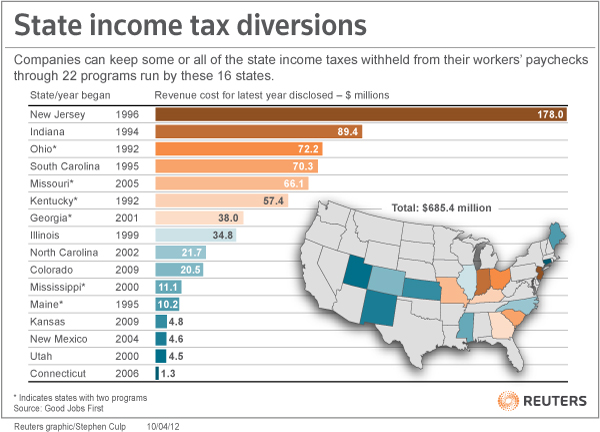
Corporate Welfare Porn: States Allow Big Companies To Keep Employees' Income Tax Withholdings


The next time you hear a wingnut conservative complaining about "welfare queens" sucking down the hard earned money of the taxpayers or griping and moaning about "socialism," here is a story from Reuters you can send to him or her as a counterpoint:
Deals cut with the states over the past two decades diverted $5.5 billion from public purposes to private gain, the report says. Close to $700 million more was diverted last year, Good Jobs First estimates.

New Jersey approved $73.2 million in new deals in 2011 on top of $178 million diverted that year alone under previous deals. I calculate that at nearly $80 per household in corporate welfare based on New Jersey’s 3.1 million households.

These deals typify corporate socialism, in which business gains are privatized and costs socialized. They also mean government picks winners and losers, interfering with competitive markets. Leaders in both parties embrace these giveaways because they draw campaign donations from corporate interests and votes from people who do not understand that they are subsidizing huge companies.

Michael Press, a Connecticut consultant on tax incentives, says such deals, however troubling, are an inevitable result of the U.S. Constitution setting up competition between the states.

“In an ideal world we would not provide any corporate subsidies,” Press told me. “It looks like corruption. But if you do it right, if you only target those companies whose behavior you change to create jobs or keep jobs in your state then these targeted temporary arrangements are cheaper – much cheaper – and can be more effective than an overall reduction in tax rates.”

The mission of Good Jobs First is making economic development subsidies accountable and effective. In years of working with their data I have always found it sound. While Greg LeRoy, Good Jobs First’s founder, has rooted out all sorts of hidden subsidies over the years, he emphasizes that he is not inherently hostile to them, only to secrecy, waste and what he calls job piracy and job blackmail.

“Job piracy” occurs when one state diverts taxes to lure an employer across state lines. AMC Entertainmentannounced a deal last year to move its corporate headquarters from Kansas City, Mo., to a nearby Kansas suburb. In return, Good Jobs First said, Kansas will let the multiplex chain keep $47 million of state income taxes withheld from its workers’ paychecks, a drain on public finances that did not create any jobs, but does enrich the Wall Street firms that own AMC including arms of J. P. Morgan, Apollo Management, Bain Capital and the Carlyle Group. AMC declined to answer my questions.

“Job blackmail” occurs when a company threatens to close a plant unless it gets tax money.

In Illinois, the law requires companies to threaten to leave before they can keep taxes withheld from paychecks. Motorola Mobility, now being acquired by Google; the truck maker Navistar; the German manufacturer Continental Tire, and three auto makers – Chrysler, Ford and Mitsubishi – get to keep $346.8 in taxes over 10 years because they threatened to leave Illinois. Navistar can pocket $62.1 million even if it fires a quarter of its Illinois workforce, its contract shows. A recent deal gives Sears $150 million, Good Jobs First reported.
Make no mistake, government has the means to put a stop to this nonsense. All that needs to happen is the 50 states all agree that none of them will grant this type of blackmail to the corporations. And the federal government could pledge to enact a prohibitive tariff on any company that sends its jobs offshore. It is also a fact that, however battered it may be, the American consumer market is still the largest in the world, and no corporation wants to lose access to that market. Government has all the leverage, it just chooses not to use it.

It will, of course, never happen because as the article points out the small army of corporate lobbyists with their large campaign checks in the state houses and in Washington collectively have more influence that the entire voting public. So expect more and more corporate welfare giveaways until the day finally comes when the whole corrupt, rotten edifice crumbles under it own weight.

Tuesday, April 10, 2012

Desperately Seeking Tax Revenue, New Jersey Stoops To Stealing Gift Card Balances


First off, it must be pointed out just what a ridiculously bad deal gift cards are. By paying, say, $5 extra to purchase a $100 card, the buyer is basically handing free money right over to whatever company issued the card. So they were already not the smartest purchase a person could make, and if the State of New Jersey persists in its latest nefarious tax collection scheme, it's about to get a whole lot worse. Here is Huffington Post Money with the details:
Like many states on the hunt to fill in budget shortfalls, New Jersey is getting creative. The state is making a grab for its residents' gift cards.

If you live in New Jersey and wait more than two years to cash in on that Red Lobster gift card that your boss gave you, you'll be out of luck. Under a new state law, New Jersey will take control of funds on gift cards that have not been used for two years. The law could potentially translate into millions of dollars for the Garden State, which would hold the gift card money as "unclaimed funds." That means New Jersey will keep that money in state coffers rather than a consumer being able to access it through the card.

But gift card makers, unwilling to part with so much money in unredeemed funds, are fighting back, pulling out their wares from the state altogether. On Thursday, Blackhawk Network and InComm, the companies behind hundreds of major name-brand gift cards sold through thousands of vendors, said they are pulling their cards from New Jersey vendors starting on June 30 if not sooner. Earlier this week, American Express pulled its cards from New Jersey retailers.

The new law would make card sellers responsible for gathering from buyers certain personal information, such as a ZIP code. That information would then be used by New Jersey to collect the unused money on the cards into the state's unclaimed money fund 24 months after the last time these cards were used.
There are a couple of issues to consider here. First there is the invasion of privacy aspect of collecting customers' personal information. But that seems to be pretty much par for the course in America these days. Corporations and the government continually push the limits in that area, and as long as the vast majority of the public remains completely asleep at the switch about it, nothing is going to even put the brakes on that particular trend.

But more importantly, exactly what justification is there for this method of tax collection? It is so completely arbitrary as to have the appearance of out-and-out theft. Don't get me wrong, I am not an anti-tax reactionary. Government needs money to operate, and taxes are the price people pay for living in any society. But those taxes should be fairly and equitably assessed and there should at least be some articulable justification for them. This asshole move fails on both counts.

Heaven forbid that the Garden State might consider a more just and equitable tax to try and make up its budget shortfall, like maybe one on all of those financial sector scumbags who live in the state. Taxing a fucking asshole banker just for BEING a fucking asshole banker is every bit as arbitrary as confiscating people's gift card balances. And you know that one of the reasons this odious law passed is that millionaire bankers don't buy $100 Best Buy gift cards.

But wait, the state might argue, this action isn't REALLY theft because we have provided a fail safe:
Procrastinating residents could still obtain any remaining balances on the gift cards by contacting the state's unclaimed funds office.
Oh yes, that is just what I would want to do if my gift card balance got confiscated, wrestle with the state government's Orwellian bureaucracy trying to get my $100 back. How much do you want to bet that the office that would field calls about such inquiries will have the biggest nightmare of an automated telephone answering system ever installed in any government office? If you are ready to abandon all hope, please press 7.

But who is ultimately responsible for this abomination? Why, you are of course. And by "you," I mean the average dumbass American consumer:
Under federal law, gift cards must be usable for at least five years after purchase, though most do not have any expiration date. Consumer advocates have criticized gift cards because consumers often forget about them or leave balances unused.

Redemption rates are low for cards and as much as $41 billion in the United States went unspent on all gift cards from 2005 to 2011. In some cases, activation or dormancy fees can eat up small amounts of money left on cards. All these things have made them lucrative for card makers.
It kind of makes you wonder why stores even bother charging the $5 purchase fee in the first place, doesn't it? You would think that sales of the cards, and hence profitable unredeemed balances, would be even higher if they just gave them out for free.

What can you say about a society which is so wealthy yet addle-minded that its citizens can afford to piss $41 billion down the sewer for nothing? There are whole countries out there that don't have a GDP that large. To put that number in perspective, it equals over $100 for every man, woman and child in America. That means the average family of four has put over $400 onto unused gift cards and have just forgotten about them. No wonder so few people get upset and protest moves like one. It's not like they even noticed just how blatantly they were getting ripped off in the first place.


Bonus: The gift

Wednesday, March 28, 2012

Converging Trends Porn: Few U.S. Cities Are Ready For Aging Baby Boomer Population


The realization that America faces a dire demographic crisis in the 21st century as the bulge in population known as the Baby Boomers reach retirement age is hardly new. It was most dramatically spelled out in the 2004 book, The Coming Generational Storm: What You Need to Know about America's Economic Future, by Laurence J. Kotlikoff and Scott Burns. So what has Spoiled Rotten Nation done to prepare itself in the eight years since Kotlikoff and Burns's dire warning? Jack shit, of course. And now, even the befuddled mainstream media is starting to notice, as shown by this article from USA Today:
Few communities have started to think long term about how to plan and redesign services for aging Baby Boomers as they move out of the workforce and into retirement.

Even more troubling, dwindling budgets in a tight economy have pushed communities to cut spending on delivering meals to the homebound and shuttling folks who can no longer drive to grocery stores and doctor's offices.

These cuts, advocates for older Americans say, are coming when the services are needed more than ever. And those needs will grow tremendously over the next two decades.

The nation's population of those 65 and older will double between 2000 and 2030, according to the federal Administration on Aging. That adds up to one out of every five Americans — 72.1 million people.

Just eight years from now, researchers say, a quarter of all Ohio's residents in half of the state's counties will be 60 or older. Arizona and Pennsylvania project that one in four of its residents will be over the age of 60 by 2020.

"The bottom line is, the Baby Boomers are hitting," Chuck Gehring of LifeCare Alliance, an agency serving seniors in central Ohio, told The Columbus Dispatch. "Are communities prepared for this? No."
The whole article is fairly lengthy and worth reading in its entirety, but I thought I would just jump right to the punch line:
"There are a lot of communities that recognize they need to do something but haven't done it yet," Sandy Markwood, the group's chief executive officer, told the Associated Press.

Some of the changes cities can make include offering training to help older people drive more safely, installing road signs that are easier to read or creating ride-share programs, said Jo Reed, who oversaw the latest survey.

The biggest reason why cities have made little progress is the economy.

Nearly 21,000 times last year, drivers for the Licking County Aging Program in Ohio took elderly residents in communities east of Columbus to medical appointments. The gasoline bill has more than doubled in the past four years, topping $7,000 a month.
Uh-oh...Houston (and everywhere else), we have a problem.

As the article explains in great detail, local communities all across the country are woefully unprepared to provide services to a rapidly aging population. Just like Kotlikoff and Burns warned years ago, government at all levels is having a very difficult time wrestling with this issue at a time when the ratio in the number of workers paying taxes to the number of retirees is quickly shrinking. But there was one very important factor they neglected to consider in their book that is dramatically illustrated by the section of the article I bolded above: the hugely negative economic impact of high energy costs.

Kotlikoff and Burns estimated that this problem would reach crisis proportions by around 2030. I think it is pretty clear, however, that their calculation is going to be off by at least a decade or so on the short end. Not only are governments at all levels under pressure from high energy costs, but young adults are finding it increasingly difficult even with a college education to land the kind of secure, good paying jobs that will allow them to pay taxes at a rate which will support the expensive programs for retirees. In the past four years, the federal government has papered over this crisis by increasing its annual deficit spending by nearly a trillion dollars per year. When we finally reach the point where it can no longer borrow such insane amounts of money, it is pretty obvious that the programs retirees are counting on to support them will quickly collapse.

Like other reality based prognosticators going all the way back to the 1970s, the warnings of Kotlikoff and Burns went largely ignored as Spoiled Rotten Nation covered its ears and continued partying like there was no tomorrow. Well, tomorrow is just about here, and there are going to be literally tens of millions of older Americans who are going to be very sorry that they didn't listen.


Bonus: "Live your life like there's no tomorrow...that's what they tell you, right? What they don't tell you is what to do when you're not dead tomorrow...that's when you've got problems"

Thursday, March 22, 2012

Community Colleges Downsize Programs


This story interested me because I am myself a proud graduate of a community college (the one eventually built at the site in the photo above, in fact, although it was later renamed "Highland"), with the Associates Degree to prove it. Being lower middle class with divorced parents who were unable to help fund my college education, attending the local community college in my town and getting all of my basic college courses out of the way cheaply before moving on to university was a big reason why I was able to eventually earn a Bachelor's Degree without piling up any student loan debt. At the time, the tuition at my community college, though far lower than college costs today, was still about one-fourth of that of even the average public university.

Anyway, here are the details from USA Today:
Community colleges across the USA, faced with tight budgets and competing priorities, are downsizing or shuttering programs that in many cases have been held near and dear for years by students and other local constituents.

•Texarkana College in Texas is one of the latest schools to drop intercollegiate sports.
•A group of older adults is working to keep alive some version of Santa Barbara City College's continuing education division, which offers free classes in subjects such as financial planning and pastry-making.

•Starting this summer, Pima Community College in Tucson will no longer offer remediation for incoming adult students who fail a seventh-grade-level test of reading, writing and math.

Two-year schools, established to serve the needs of their local communities, "can't do it all anymore," says Suzanne Miles, Pima's interim president. She estimates the school's decision will affect no more than 2,000 students this fall.

State funding cuts are one culprit. For instance, state funding for California community colleges has been slashed $809 million, or 12%, since 2007-08. Another driver: a growing emphasis on improving degree-completion rates and retraining displaced workers. President Obama has made both central to his higher education agenda.
And thus is a sensible higher education option for working and middle class families that won't burden their children with unpayable debt slowly falling by the wayside.


Bonus: A little tune from the best damn college band from back when I was in school...and a good anthem for how I feel in middle age

Saturday, March 10, 2012

$3 Million In Government Largess Not Enough To Keep International Battery Plant Open


The conservatives who were trying to score political points by bashing the Obama Administration over its failed loan guarantees to solar panel manufacturer Solyndra really need to stop with the hypocrisy, because it has become readily apparent that such practices are widespread all across the country, and usually involve pro-business types at the local level. Here is the Lehigh Valley Morning Call with the latest such story:
International Battery, which opened an Upper Macungie plant in 2008 that was expected to create hundreds of jobs, has abruptly closed without explanation, workers said, surprising local officials who worked for years to attract the company to the Valley.

One worker, who declined to give her name, said employees were told Wednesday that the business was closing. Two representatives at the company's Snowdrift Road office who declined to be identified confirmed the closure Thursday. The company parking lot was nearly empty and only a few people were inside.

"We're closed," one man in the office said to a Morning Call reporter. "No one is going to talk to you about it."
Seems rather abrupt and frankly a bit rude. So what's the rest of the story?
International Battery, which makes rechargeable lithium-ion cells and batteries for the military and industrial uses, was seen as a recruiting win in 2008 when it decided to invest millions of dollars in the Lehigh Valley and create manufacturing jobs.

The state gave the company a package of incentives, including $500,000 in job creation tax credits, $500,000 in grants and a $3 million loan for machinery and other equipment. It initially employed 70 people and was expected to grow to 250 workers over three years. Officials said it represented the kind of good-paying, high-tech jobs the Valley needed.

"It comes as a very big surprise," said Phil Mitman, president and chief executive officer of Lehigh Valley Economic Development Corp., an agency whose goal is attracting new businesses to the Valley and retaining existing ones.

Mitman said the company did not come to the agency for assistance to stay in business.
Well, why should they? You handed them $3 million of taxpayer money and apparently didn't get any guarantees from them that they wouldn't just slam the door in your face any time they felt like it. Brilliant move, Mr. Mitman. Can I sign up to be your next loan recipient? I've got a great business plan for building a factory that makes saddles for unicorns.


Bonus: This video is dedicated to Lehigh Valley Economic Development Corp. CEO Phil Mitman in honor of what he thinks it is appropriate to do with taxpayer money

Thursday, March 8, 2012

L.A. County Court System To Lay Off 350 Employees Due To Budget Cuts


Last October, I posted a story about overcrowded court systems suffering due to staffing cuts. Here comes the latest such tale of woe from the Los Angeles Times:
The Los Angeles County Superior Court system is expected to lay off about 350 employees in June and "restructure" more than 50 courtrooms because of deep cuts in funding by the state, according to a memo obtained Tuesday by The Times.

The latest reductions come after the court has already reduced staff by 500 -- or about 10% -- due to layoffs and attrition over the last two years.
More troubling was this quote:
"These changes will affect every judicial officer and staff member -- as well as the millions of attorneys and litigants who depend upon our courts to deliver justice," Presiding Judge Lee Smalley Edmon and Executive Officer John A. Clarke wrote in the four-page memo. "Nonetheless, there is no escaping the fact that this next round of cuts will be the most significant event to happen in our court .... Never before has a budget crisis dealt so crippling a blow to our court."
A lot of people in the peak oil and "reality based" communities often ask when exactly collapse is going to come to America. Take this as yet another sign that collapse is already here--it's just happening in slow motion.


Bonus: "Next time you come into my courtroom, you will look lawyerly"