Thursday, September 15, 2011

USPS Looking To Close Half Its Processing Centers, Cut 35,000 Additional Jobs


Just a quick update on my continuing coverage of the impending implosion of the U.S. Postal Service. Here's The Consumerist with the gory details:
With dark financial skies looming on its horizon, the U.S. Postal Service has already talked about closing thousands of post offices. But that's apparently not going to be enough to salvage the sinking ship, as USPS announced today it may close or combine 252 of its existing 487 mail processing centers.

The changes are expected to result in 35,000 USPS jobs being cut.

"We are forced to face a new reality," Postmaster General Patrick Donahoe said in a statement. "First-Class Mail supports the organization and drives network requirements. With the dramatic decline in mail volume and the resulting excess capacity, maintaining a vast national infrastructure is no longer realistic."

While the cuts will help save the service billions each year, it will also mean a delay in the delivery time for mail sent using a first-class stamp. Minimum delivery time for these items would now be two days.
For those of you keeping track at home, that's 35,000 additional layoffs on top of the 120,000 previously announced for a total of 155,000 postal service employees soon to lose their jobs. President Hopey-Changey better get that jobs bill passed through Congress soon, otherwise people might begin to think he doesn't care, or something.

Dollar Stores Are Winning the Final Retail Race to the Bottom


I came of age during the 1970s, just as American retailing was entering its golden age. The first big indoor shopping mall opened up in the nearby Illinois city of Rockford about the time I became a teenager. I still remember how thrilled I was when my dad took us all there for the first time on the day after Thanksgiving to do our Christmas shopping. Back then, "Black Friday" was an as yet uncoined term, and we did not wrestle or get into fistfights with our fellow shoppers over the last deeply discounted toaster oven or hand held video game.

In fact, I don't remember buying very much at all on that trip as I was still a kid and didn't have a whole lot of money. It was enough of a joy just to walk up and down the length of the biggest building I'd ever been in up until that time gazing upon all the merchandise I would ever have thought I'd want to buy.

Back in my hometown of Freeport, Sears and JCPenney were the two department stores where most people did their shopping. We were a solidly middle class family, which meant that probably half the stuff in our house came from one or the other. About the time I entered high school, a K-Mart opened up on the other end of town. I didn't think too much about that, but I noticed my parents would rarely ever go there.

Freeport managed to survive without a Wal-Mart until after I left for college in the late 1980s. And though I wasn't aware of it at the time, Wally World and K-Mart combined over the next decade or so to slowly strangle the old, historic downtown business district in a way that Sears and JCPenney never did.

For a long time in America, it appeared as though the omnipresent Wal-Mart--with its low wages, lack of employee benefits and ruthless business practices--represented the bottom line-driven endgame for American retailing. No matter how much the chain contributed to undercutting and driving mom-and-pop stores all over the country out of business, consumers still flocked there searching for bargains.

But now, as the Great Recession lingers and deepens, even Wally World is starting to come under pressure. Just how much pressure was reported in a Reuters article on Monday about a public opinion poll showing that holiday shoppers are planning to cut back this year. Here's the relevant snippet:
"Retailers better be worried about Christmas. If half of Americans believe it is going to be worse before it gets better, they may not be too excited about buying much this Christmas season," Britt Beemer, president of America's Research Group, said in an interview.

The holiday selling season is vital for U.S. retailers as many of them make as much as a third of their annual sales in that period.

"This is not the kind of number that retailers want to have going into November 1 or they are going to be in big trouble," Beemer said. "They are going to have to give consumers better deals earlier."Fewer pay raises, falling home values, rising prices for food and other goods, and political gridlock in Washington are all taking a toll on Americans, Beemer said.

"Not that there is no hope at the end of the tunnel, but the light is very, very dim," he said.

Post-recession American shoppers are extremely sensitive to price and increasingly venturing beyond discount chains while hunting for bargains.

About 68 percent of those surveyed said they have now started shopping at dollar stores; 42 percent said dollar stores offered better value than discounter Wal-Mart Stores Inc.

That is bad news for mass merchandisers such as Wal-Mart, Target Corp, Family Dollar Stores Inc and Dollar General Corp.

"Anybody who is another discounter that sells commodities is vulnerable," Beemer said. "Dollar stores are attacking them at their lowest price level.
First the department stores succumbed to the discount stores, and now the discount stores are succumbing to the dollar stores. When millions of American shoppers no longer feel prosperous enough to go to Walmart, the final collapse of the American consumer-based economy surely cannot be too far away.

Wednesday, September 14, 2011

The Automobile Claimed its First American Life 112 Years Ago Today


I ran across this interesting tidbit posted by a fellow blogger today:
Henry Bliss, a Manhattan real-estate salesman, became the first American to die by car more than a century ago on this day. Wired offers a fuller account of how a taxi hit him and "knocked him unconscious, crushing his skull and chest" in 1899. Bliss died by the next morning, and the driver was initially charged with manslaughter, though the charges were dropped.
I say interesting because it serves as a reminder of how relatively brief the age of the automobile has been. No invention of man has been as responsible for dramatically altering the physical landscape, particularly here in America. And yet, because of Peak Oil, the auto age is going to prove to be very brief indeed. My personal estimate is that within 20 years, nobody but the very rich will still own private autos, and by midcentury the only cars remaining will be rusted hulks littering the powered down landscape.

Oh well. Despite all of the environmental damage they have caused and the continuing carnage on the roadways, of which the unfortunately named Mr. Bliss was merely the first of millions of victims, it was actually kind of fun while it lasted.

Why “Drill, Baby Drill” Won’t Save Us from High Gas Prices


Probably the dumbest meme to arise during the 2008 presidential campaign was the catchphrase, “Drill, Baby, Drill,” as a solution to high gasoline prices. It contained all of the rhetorical elements beloved by our nation of waddling ignoramuses: a simplistic, sexually suggestive slogan guaranteed to piss off the libruls, and as an added bonus could also be turned into the title of a country music song. The morons who shouted it the loudest (while no doubt fantasizing about Sarah Palin in a dominatrix outfit) apparently believe that if we ram a drill bit into every bit of the Earth’s crust from the Arctic National Wildlife Refuge to the front lawn of Hemmingway’s house in Key West, gasoline will drop back to $1.20 a gallon again and allow them to rev the engines of their F-150 pick-‘em-up trucks at every red light as is their God-given right as Americans.

The main problem with this line of “thinking,” as has been pointed out by Peak Oil activists, is that even disregarding the environmental concerns, America’s undeveloped arctic and offshore oil fields would take many years to come online even if development were to begin immediately. Moreover, once they do begin pumping oil, production will not yield nearly enough to offset even the decline in our already-existing domestic fields. Peak Oil, it needs to be repeated ad nauseum until it reaches a level of general public understanding, does not mean we are “running out of oil,” but that the FLOW RATE of oil produced is no longer increasing and is actually beginning to decline.

Yet there is another factor which demonstrates just how little understanding the DBD knuckleheads have of how things work in the real world. Say America got really lucky and somehow discovered another “supergiant” oil field like the one on Alaska’s North Slope. Better yet, let’s say this big ol’ field is actually located in the lower 48 states and is easily accessible to drilling.

Whoo-hoo! Happy days are here again. Fire up the Hummer, Honey, we’re going for a ride! Because surely if that happened, America’s oil companies would keep all of that bounty here at home for us fine folks to enjoy, right? After all, they are good, red-blooded, freedom-loving patriots, aren’t they?

Wrong again. Man, you have a miserable track record when it comes to predicting how these things are going to play out.

Don’t believe me? Well then check out this little tidbit from an article about the high price of gasoline that appeared in the Los Angeles Times on Tuesday:
Carol Hill, a 25-year-old Los Angeles resident who works as a waitress at a Santa Monica restaurant, said she was unhappy paying $3.95 a gallon recently to fill her 10-year-old Honda Accord.

"The price of gasoline always goes up every year and never falls by as much," Hill said. "There's always some excuse someone has. All I know is that I'll be very happy the day someone hands me the keys to an electric car."

Fuel prices have been rising despite weak demand.

Energy Department statistics show that gasoline demand in the U.S. is running 157,000 barrels a day below 2010 levels. At the same time, gasoline stocks in the U.S. are down 16.3 million barrels below last year, at 208.8 million barrels, even though refinery outputs are high.

Rising inventories in periods of weak demand are one of the things that drive retail prices lower, but the refined fuels aren't staying here; they are going overseas.

In just the last few months the U.S. has become a net exporter of refined fuels, according to Energy Department statistics. That's a big change from as recently as May, when U.S. imports of refined fuels exceeded exports by 800,000 barrels a day. Most recently, exports have been running ahead of imports by 467,000 barrels a day, with much of the fuel going to Latin America and South America.

"We do know that there have been more sales overseas this year compared to previous years," said Gregg Laskoski, a senior petroleum analyst for GasBuddy.com, a price-posting website. "That has been most evident in the Midwest. When we look at the BP Whiting refinery in Indiana, which is one of the largest in the country, you see the output is strong, yet we are still seeing a lot of high prices in the markets this refinery is serving."

Laskoski added, "It's troubling for consumers to try to reconcile the high price they see at the pump when the seemingly local refineries that served them in the past are now outsourcing more of their products overseas."
Did you catch that? If not let me repeat it for the record: “the refined fuels aren't staying here; they are going overseas.” Yes, that’s right. In a year in which (according to that same article) the average price per gallon that Americans pay for gasoline is expected to set an all time high, topping even 2008, domestic oil refineries are shipping a large amount of their products overseas, inflating the cost of gasoline to a higher level than it would otherwise be if that were not happening.

You would think the DBD idiots would be OUTRAGED by this development and be loudly and rancorously DEMAINDING that the practice be stopped. And yet all we hear from them on this issue are crickets.

Why is that, do you suppose? If you answered, “Because the whole asinine campaign was funded by billionaire oil and gas interests who just want end all environmental restrictions on drilling,” you win a cookie. And now we see that they don’t even want the restrictions lifted so they can produce more oil domestically and bring price relief to American consumers. Instead, they want to suck as much of the stuff out of the ground as possible in order to maximize profits.

This would all be absolutely hilarious if the consequences weren’t so damn dire. President Obama, for example, may not have benefited from the DBD campaign, which after all was aimed at liberals and Democrats. But it was that mindset that caused his administration to give carte blanche to British Petroleum even after the worst deepwater drilling disaster in U.S. history befouled much of the Gulf Coast.

Clearly, the DBD clowns are as big a stooges carrying out the will of our corporate overlords as are the Tea Party activists. The sheer ease with which these people allow themselves to be manipulated against their own self-interest is breathtaking. Somewhere, down in the deepest, darkest depths of hell, Joseph Goebbles must be looking up at us and knowingly smirking.

Tuesday, September 13, 2011

Ben Bernanke + Climate Change = Higher Peanut Butter Prices


Part of my job as a blogger is to sit around analyzing seemingly unrelated news stories, establishing links that are often missed by the mainstream media. Usually, it really isn’t all that difficult. You would think the reporters could do this stuff themselves, except for the fact that they are all hyper-allergic to engaging in any form of speculation on issues of real importance, lest they offend their corporate masters and get themselves fired.

I’ve documented on this blog numerous times how Federal Reserve Chairman Ben Bernanke’s reckless Zero Interest Rate and Quantitative Easing policies have driven up the costs of food and energy around the world. Because the dollar is the world’s reserve currency, and thus is the preferred method of valuing commodities in international trade, any action that causes it to slip in value makes those commodities more expensive. In the case of agriculture products, the effect has been magnified because of poor harvests resulting from the recent run of historically bad weather. When these two factors combine, you get stories like this one last week from the Cleveland Plain Dealer:
First gas, then coffee, and now peanut butter.

Consumers fed up with the higher cost of filling up their cars and buying their morning java might now have to pay more for their PB&J.

Scorching hot, dry weather in the major peanut-growing states like Georgia and Texas has devastated this year's peanut crop.

Some plants shriveled before they could produce peanuts, while other plants got too hot to mature into anything edible. And some of the plants that did mature developed a toxin that makes them more difficult to process.

The U.S. Department of Agriculture is predicting this year’s peanut crop could be about 3.61 billion pounds, 13 percent smaller than last year's 4.16 billion pounds.

Bottom line: Consumers will see higher prices on peanuts and peanut butter at least through the winter.

"In my 20 years in the nut business, I've never seen peanut prices this high," said Marty Kanan, president and chief executive of the King Nut Co. in Solon.
I have a confession to make. Peanut butter is very much a guilty pleasure of mine. I got hooked on the stuff as a kid and I can’t seem to kick the habit. Good thing I have low cholesterol by heredity. That said; paying a higher price at the supermarket for my occasional jar of Jif isn’t going to break my bank account. The people this is going to hurt are the ones on the lower end of socio-economic ladder. Besides being tasty, peanut butter provides a cheap source of protein to those without a whole lot of money to spend, like, say, food stamp recipients.

I checked over the entire article and there wasn’t a single mention of climate change or the fiscal policies of the Federal Reserve anywhere to be found. There was, however, this quote:
(Executive Director of the Georgia Peanut Commission Don) Koehler said supplies are plunging just as consumption has reached record highs, which he credits to Smucker and its “Choosy Moms Choose Jif” commercials.

Smucker is the world's largest buyer of peanuts for roasting, he said.

"If everybody goes out right now and buys it off the shelf, it's going to take that much longer to replace it and cost that much more," he said. "If we can make it through this year," next year's crop looks much more promising, he said.
I’m not sure what rock Mr. Koehler has been living under, but I remember that same television advertising slogan for Jif peanut butter from when I was a kid decades ago. Attributing the increased demand to an advertising campaign old enough to BE a mom is simply daffy. The reason everybody is going out and buying peanut butter off the shelf, Mr. Koehler, is because they can no longer afford prime rib or even ground beef anymore. If you were a food stamp recipient with just $133 a month to spend on your sustenance, peanut butter might be high on your shopping list as well. And when you consider that the number of food stamp recipients has increased from around 27 million to over 45 million since 2007, the cause of the increased demand for the stuff isn’t too difficult to comprehend.

I guess it really is too much to expect mainstream reporters to stop acting like glorified stenographers just copying down without question whatever the people they interview tell them. But in a way I’m grateful, since calling them out on it is part of what makes blogging so fun and rewarding these days.

Monday, September 12, 2011

CNN Tells the Stark Truth About Rising College Costs


I'm going to get this out of the way right up front: the time-honored American Dream of parents sending their kids off to college so they can get a higher education that will allow them to live better than they did is dead as doornail. Just how bad is it? CNN reports in an article entitled "Stop the Tuition Madness":
For parents with college-bound kids, it seems like a no-win situation. Your child is eyeing the grassy quads and Gothic dorms of Dream U., while you're staring down at a too-small 401(k), a shaky job market, and a house worth a lot less than a few years ago.

Meanwhile, colleges are bidding up tuition prices faster than a hedge fund manager at an art auction. Over the past 10 years the cost of private college has jumped more than 60%, nearly three times as much as incomes over the same period, and will now set you back $42,000 a year on average.

Prices at public colleges have shot up even more, nearly doubling to $21,000 for in-state students. Got younger kids? By 2020 you're looking at a four-year bill that's likely to top $240,000 for private schools and $155,000 at public universities. Sure there's financial aid, but scholarships aren't keeping up with tuition inflation. So long, retirement hopes; hello again, boss.

Your children will suffer, too, if they're forced to start their adult lives with onerous debt. "Student loans can affect every decision young adults make: whether they can go to graduate school, buy a house, even start a family," says Patrick Callan, president of the Higher Education Policy Institute.
I actually have one nit to pick with that excerpt from the story. There is no way college tuitions are going to rise from their already lofty heights to those insane levels by the year 2020. It should be obvious that we are already reaching the point of Peak Higher Education, in which the mounting price tag for even a Bachelor's Degree at a public university is rising beyond what's affordable for most people even with student loans. The $155,000 figure cited as the future cost for a four-year degree is about three-and-a-half times the current median annual household income (around $45,000).

At some point, the growing consciousness that a college education no longer guarantees a good salary or even any employment at all upon graduation is going to reach critical mass, and enough students (and their parents) are going to balk at taking on a six figure debt only to end up at best waiting tables at Applebees five years later. Once that happens, the higher education system in its current form is going to collapse.

Many will lament its passing, but it really is for the better. Except in rare instances, universities long ago largely stopped being places where students could learn for knowledge's sake and expand their minds to become better citizens. Instead, a university degree had become merely a ticket that needed to be punched to gain admittance into the white collar corporate world.

The rapid rise in tuition costs, which for well more than a decade have greatly exceeded the rate of inflation, very much encouraged the transformation of our universities into mere job factories. Even if obtaining a high paying job wasn't a student's first motivation for attending college, it likely moved high on the list once they started to realize how much debt they were going to have to take on to obtain that degree. As for the colleges themselves--beyond enabling big, fat pay raises for administrators, professors and football and basketball coaches--the need to keep their cash cows from dropping out no doubt also greatly contributed to the grade inflation that has turned, for example, attaining a "B" average from a genuine academic achievement into a complete joke.

The CNN article actually goes on to propose a list of potential solutions for curbing college costs, which wouldn't be half-bad if we were still living in "normal" times. I particularly like the idea of cutting way back on the expensive college football programs. Sadly, however, like most mainstream media articles this one assumes that the system can be "saved" by making a few tweaks here and there, when in truth the effects of peak oil and resource depletion and the fact that we have now entered the age of permanent contraction means that the system itself is soon going to follow the old Communist bloc into the dustbin of history.

Sunday, September 11, 2011

The Texas State Association of Firefighters Endorsed Rick Perry--Right Before He Kicked Them in the Nuts


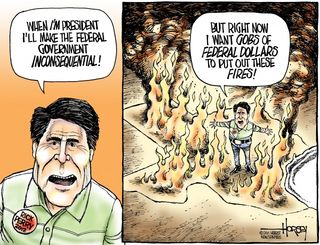
It has by now been widely reported how Texas Governor and Republican presidential campaign front runner Rick Perry gutted his state's firefighting budget just in time for the breakout of massive wildfires this summer that have consumed much of his state. Just how much those budget cuts contributed to the death and destruction recently wreaked upon Texas is a matter of debate, but it likely was not inconsequential. To recap, here are the gory details from the Huffington Post:
In Texas, firefighters aren't just battling the wild fires raging around Austin and Houston. The state's first responders have also had to deal with budget cuts affecting everything from fuel purchases to hoses and air tanks.

In some cases, fire officials say, firefighters have had to pay out of pocket for basic necessities like proper protective gear and fuel to get them to the scene. One fire department that battled the blazes in Bastrop County had to pay for a hose, recalled Bastrop City Fire Chief Henry Perry, speaking to The Huffington Post during a break from working the wild fires.
In light of the above. you might be under the assumption that Governor Perry and the Texas firefighters are political antagonists. Well, you would be wrong in the assumption. Here is another quote from the same article:
The cuts come at a time when Texas fire departments have already been slowing purchases of new fire trucks and other critical equipment as a way to save money, said Guy Turner, president of the Texas State Association of Fire Fighters. The association had endorsed Perry in his re-election for governor in 2010.

"What I fear will happen is equipment will start to fail and put our members at peril," Turner explained. "You can imagine if you're inside a structure fire and your engine quits."

Turner doesn't have to imagine it. He said he knows of firefighters whose breathing apparatus has malfunctioned during fires. There have also been "instances of hoses failing during the course of firefighting operations."

"For years, public safety was the golden calf -- that we were untouchable," Turner said. "Nobody's untouchable. It is a shame. They are basically putting a price on how much our lives are worth. It's disturbing at best."
I certainly agree with Mr. Turner that putting a price on firefighters' lives is "disturbing." But perhaps Mr. Turner ought to take a good look in the mirror and asses how it was that he gave his enthusiastic endorsement to the same man who was so willing to put that price tag on their lives. Here is a quote from Mr. Turner upon his organization's endorsement of Perry almost exactly one year ago today:
“Gov. Rick Perry has consistently supported the issues relating to public safety, and has been a dedicated advocate of health and safety for professional fire fighters and EMS workers across Texas,” said Guy Turner, president of TSAFF. "For his long friendship and support, the Texas State Association of Fire Fighters, representing almost 16,000 fire fighters and emergency medical workers in 170 jurisdictions is proud to endorse Governor Rick Perry in his bid for re-election.”
Guy Turner should immediately resign. And if he refuses to do so, then the 16,000 firefighters and emergency medial workers he claims to represent should DEMAND his resignation. You cannot blunder this badly in looking out for your organization's best interests and still be taken seriously as its president.

Nevertheless, I wouldn't wager a nickel that Mr. Turner, or Perry for that matter, will suffer very much politically as a result of this scandal. For whatever reason, Americans have completely lost the ability to demand accountability for anyone who rises into a supposed leadership position in this society, just so long as they are not involved in a sex scandal. Perry will continue to score points on the campaign trail by bashing the government despite the dramatic evidence of the damage his actions have wrought upon his own state.

Happy 9/11 Anniversary, First Responders--Here's Your Pink Slip


I'm doing my absolute best to ignore all of the superficial patriotism being brought out during today's 9/11 tenth anniversary remembrances. Nevertheless, I managed to stumble across a recent news story that seems perversely ironic in light of all the fetishistic worship of first responders during these ceremonies. Not that the police and fireman who responded on that day didn't do so in an heroic manner. I'm not questioning that at all. But just like with the soldiers who subsequently saluted upon being told they were going to Iraq and Afghanistan and then went and did their duty, our collective words of praise for their service ring hollow when compared to our actions.

For proof, look no further than an article that appeared on Friday on the website of a local Florida television station:
To make up for a $4 million budget deficit, Cape Coral City Council members are considering laying off members of the fire and police departments.

Previous reports have estimated up to 11 police officers and 21 firefighters could be laid off.

At least one Cape Coral Council member says layoffs are imminent, but the number of layoffs evolves every day.

Donna Weaver says hearing a siren is a reassuring sound. But soon there may be fewer sirens.

Fire station 4, just blocks from her house, could be one of three hit by budget cuts.

"To know there would be less responders is a big concern," said Weaver.
Memo to Donna Weaver: if you are really that concerned about there being fewer first responders, then you should DEMAND an immediate end to the wars in Iraq and Afghanistan and a significant draw down in the American military presence overseas. For it's now becoming dramatically obvious that by "fighting them over there" we are making ourselves far less safe over here.

The Statistical Tenth Anniversary of 9/11


I don’t have all that much to say about today’s 10th anniversary of 9/11. I was about three miles from the Pentagon on that awful morning; almost close enough to have witnessed the plane crashing into its side. A friend of my wife was working there at the time, but she made it out okay. I remember saying to my wife at home that evening that the world would never be the same. I was right, of course, but in so many ways that I would never have expected.

Rather than rant and rail and the sheer and utter collective and bipartisan stupidity of our government since that day, I thought I would let the statistics (hat tip to Antiwar.com) do the talking instead:

U.S. Military Deaths in Afghanistan = 1752

U.S. Military Deaths in Iraq = 4474

Other Military Deaths in Afghanistan = 947

Other Military Deaths in Iraq = 318

Total U.S. Military Wounded in Iraq = 33,139

Total Civilian Deaths in Iraq = over 100,000

Total Cost of War in Iraq = over $794,000,000,000

Total Cost of War in Afghanistan = over $452,000,000,000

Total Combined Cost of Wars = over $1,246,000,000,000

"Every gun that is made, every warship launched, every rocket fired signifies in the final sense, a theft from those who hunger and are not fed, those who are cold and are not clothed. This world in arms is not spending money alone. It is spending the sweat of its laborers, the genius of its scientists, the hopes of its children. This is not a way of life at all in any true sense. Under the clouds of war, it is humanity hanging on a cross of iron." – Dwight D. Eisenhower

Saturday, September 10, 2011

Peak Banking: Has the Recent Explosion in Branch Locations Finally Stopped?


I didn’t conduct any research to confirm this, but during the last decade probably no commercial enterprises in America have enjoyed greater growth in the number of locations than bank branches and drug stores. Within just a few miles of my home here in Northern Virginia, for example, at least a half-dozen of each have sprung up during that time frame, and construction of additional locations was hardly slowed down by the effects of the Great Recession despite the banking crisis that started it all. It got to the point where I was no longer excited at seeing a new retail construction project being started around here, hoping it might portend the establishment of an interesting new restaurant or something. Instead, it almost invariably turned out to be yet another Walgreens, CVS, Capital One or PNC Bank.

So I was rather gratified to see a report that appeared on Thursday in The State newspaper of South Carolina concerning Bank of America’s plan to begin, if you’ll pardon the pun, trimming its branches:
Bank of America will close up to 600 branches as part of its reorganization and cost-cutting moves, according to multiple reports this morning.

Published and broadcast reports say Bank of America will split into separate consumer and commercial units, and that will lead to the branch closings.

Charlotte's NewsChannel 36 says analysts believe the decision to split into two units and close the branches is a signal that Bank of America CEO Brian Moynihan plans broader and deeper layoffs than those announced earlier this week.
I realize that this move is going to cost a lot of Bank of America employees their jobs, but I still can’t help but be gratified that it would appear reality is finally setting in for the big banks that their project to blight the American landscape by putting a branch location on every street corner is finally coming to an end. I will also never be accused of having a good head for business, but it never made any sense to me how this rampant construction could be at all profitable. Presumably, it costs a lot of money to acquire the land and build the structures, and then even more money for utilities and employee salaries. No wonder we’re lucky to earn 1% interest on our savings accounts these days.

Bank of America is, of course, in deep, deep trouble for reasons other than trying to pave paradise with the parking lots of all of its branch locations. Just how much trouble, no one really knows because the whole banking system is rampant with government-sanctioned fraud and obfuscation. Nevertheless, the specter of a BofA collapse hangs over the American economy like a faulty upstream dam bursting at the seams from a recent deluge. When it finally breaks, here's hoping that many ugly bank branch locations and even a few of those redundant drug stores will be permanently washed away.

Friday, September 9, 2011

Friday Rant: Obama’s Jobs Proposal is Nothing More Than the Same Old Shit Again


One of the silliest political flaps of Obama’s presidency was the derision heaped upon him for using a teleprompter while making his speeches, as if we were back in the days when men still wore top hats out in public and politicians routinely delivered two-hour speeches from the back of a train car to rapt audiences that they actually composed themselves rather than relying upon a whole team of speechwriters. The manufactured controversy resulted in some labeling Obama the “Teleprompter-in-Chief,” which is actually a very fitting label, just not in the way it was intended by its originators. The phrase could instead be better interpreted as meaning that Obama is really just all flash and rhetoric, but utterly without substance, which is pretty much my take on the man 32 months into his presidency.

Obama demonstrated yet again that he is nothing more than an arrogant, empty-suited con man getting by on his exceptional gift of gab last night during his long-awaited jobs speech. I say “long awaited,” merely because that’s how the media insisted upon describing it. Personally, I wasn’t waiting for it at all because I knew it was going to end up being just what it turned out to be: a whole lot of sound and fury, signifying nothing.

Let’s put aside the finer details for a moment and look at the big picture. At the beginning of his presidency, Obama pushed through the American Recovery and Reinvestment Act at a total cost of $787 billion, most of which has already been spent. Even is this age of trillion dollar budget deficits that are well beyond the cognitive comprehension of most people, that’s a lot of damn money. So what did we get as a result of all that federal largess? Anemic 2011 GDP numbers and an August monthly jobs report that came in at a big, fat zero net jobs created. Clearly, the tired old liberal trick of throwing tons of money at a problem to make it go away doesn’t work anymore.

Nevertheless, the headline for Obama’s “new” jobs proposal announced that the package was going to cost around $450 billion—or around three-fifths of the amount pumped into the economy by the Recovery Act. Upon seeing that number, the very first question that ought to pop into any thinking person’s head should be: if $787 billion didn’t revive the economy, how can we expect spending far less than that amount to work? The second question then should be: how in the hell are we going to pay for it at the same time the deficit reduction commission is planning to recommend more federal budget cuts in November?

But the inadequacy of the plan is even more obvious when you peek behind the headline number at some of the sordid details. Of the $450 billion cost of the proposal, a substantial portion will come from extending and increasing the payroll tax reduction passed last December and by extending long term unemployment benefits. I’ve written in these pages several times about how the payroll tax deduction is merely hastening the day of the Social Security program’s ultimate demise, and while maintaining long term unemployment benefits in the wake of our ongoing jobs crisis is certainly the humane thing to do, the fact is that we’re already doing both of these things without any discernible effect in turning the economy around.

So the real figure for new programs in the proposal beyond what is already being done is only about half of the headline total, or in other words less than one-third the amount of the utterly ineffectual Recovery Act. Additionally, most of the rest of the proposal contains a similar mishmash of infrastructure projects and aid to the states that made the Recovery Act such a colossal boondoggle. No word yet as to whether there are any other fraudulent but politically connected solar panel manufacturers with their hands out waiting to steal some of this loot.

If he had a single honest bone in his body and wasn’t actually a complete and utter fraud, President Hopey-Changey would have simply called this his “No Hope” speech, as that is essentially the real message he’s sending to the unemployed. But because so much of the American electorate still has its head planted so firmly up its ass, there are no doubt millions of delusional souls out there who took comfort and saw this speech as evidence that their president really cares about their plight.

So now comes the really big farce—the political fight in Congress over getting Obama’s proposal passed. Oh joy. The Republicans get to pander to their base about the cost of the program at a time of deficit reduction while the Democrats will yell and scream that the Republicans are actually in favor of “killing” the economy. The spectacle will be good for nothing more than providing the grist for partisan fundraising letters as well as for endless farcical talking head shouting matches on Fox News and MSNBC.

We in the peak oil community should take solace in the knowledge that we won’t be fooled into thinking any of this has any relevance whatsoever. The end of cheap oil means the end of the long era of economic expansion. We’ve now entered the age of permanent contraction, and no jobs program based upon defunct economic models assuming that it is possible to have infinite growth in a finite world is going to have any chance of succeeding. It would have been far better, of course, if Obama had leveled with the public about our true predicament so that people can begin to make the necessary adjustments to their lives. But since there is exactly zero chance of that ever happening, I guess we have no choice but to just kick back and enjoy the freak show.

Thursday, September 8, 2011

FBI Raids Bankrupt Solyndra as Lawmakers Question Panel Maker’s Finances


In my September 1st post, "Half-a-Billion in Taxpayer Dollars Down the Drain for a Solar Energy Pipe Dream," I wrote about the bankruptcy of the Solyndra corporation a mere two years after the company received over a half-a-billion dollars in loan guarantees from the Department of Energy. At the time, I concluded:
To be that far off the mark with your business model, you have to be either completely incompetent or totally delusional.
Guess I spoke a little too soon, as there was actually a third possibility: rampant fraud. Here's Bloomberg with the story:
The FBI raided the headquarters of Solyndra LLC, the solar-panel maker that failed after receiving $535 million in loan guarantees from the Obama administration.

Republican lawmakers said after the raid that the administration made misleading claims about the company’s prospects, and Democrats said the company’s chief executive officer withheld information on its financial plight.

The Energy Department gave the Fremont, California-based company the most federal backing awarded a solar manufacturer. One of the principal investors in Solyndra is a foundation headed by billionaire George Kaiser, a campaign supporter of President Barack Obama who made 16 visits to the president’s aides since 2009, according to White House visitor logs.

The Federal Bureau of Investigation executed a search warrant today with the Energy Department’s inspector general, bureau spokeswoman Julie Sohn said in an interview. Sohn said she couldn’t provide details about the investigation. Solyndra filed for bankruptcy protection on Sept. 6 with liabilities of $783.8 million, after shutting its factory and firing 1,100 people.
The raid's timing couldn't have been any more awkward for President Hopey-Changey, coming on the same day as his jobs speech in which he is widely expected to offer up a plan to throw more money around willy-nilly in a futile attempt to restart the broken American jobs machine. This story also has the potential to blow up into a major political scandal for Obama. Stay tuned.