Wednesday, June 15, 2011

Trip Report: Bermuda is Doomed, Part 1 (or What I Did on My Summer Vacation)


I try not to make this blog too much about me. There are many more pressing issues out there to write about and my life really isn’t all that interesting anyway. So I promise I’ll limit the ruminations as to what’s going on in my world to just those instances when I think it’s relevant to the overall theme of The Downward Spiral. With that qualification, please indulge me as I recount what I did on my summer vacation.

If there is a more decadent way for a middle class person to spend a week of his or her time in the twilight of the cheap oil era than taking an ocean cruise, I don’t know what it is. These modern massive cruise ships accommodate over 2000 passengers, have many hundreds more crew members, and gobble up more nonrenewable resources than I care to imagine. Nevertheless, it was a nice thing to do with the missus, and I was looking forward to seeing Bermuda the same way I always look forward to traveling to some corner of the world where I’ve never been before. Travel expands the mind even more than drugs do, and I’m WAY too old at this point in my life to be taking illegal pharmaceuticals.

But first you gotta get there, and while the ship we were on had every imaginable luxury and was about as well run as such an operation can be, the downside was being cooped up on board for a couple of days with a large horde of entitled, clueless middle class Americans. This crowd skewed older; probably well more than half of the passengers were couples in their 50s and 60s—in other words a perfect sampling of the Baby Boomer generation that won the golden lottery ticket of growing up during America’s postwar, cheap oil fueled economic bonanza.

Had you been dropped out of the blue onto one of the decks of that ship without having any idea where you were, the first thing that would have struck you is just how obviously soft and spoiled most of these people were. More than half of them were overweight, ranging from a bit pudgy to grotesquely obese—quite a repugnant sight when everyone is running around in their bathing suits, let me tell you. Making matters worse was the tattoo ink scrawled across much of that flab. I’ve never figured out why people with bad bodies are so keen to draw attention to their least attractive features, but then again there are a lot of things I don’t understand about my fellow Americans these days.

Nevertheless, we were determined to enjoy ourselves and not be distracted from being in the midst of a floating State Fair. Sometimes though, we couldn’t help but be dismayed, like when the otherwise seemingly sensible retired bus driver at our dinner table started going on and on about how Obama was born in Kenya and thus wasn’t eligible to be President. I wanted to reply that there are so many LEGITIMATE reasons to criticize Obama and that the Birther issue merely serves as a media-manufactured distraction that helps to drown out and discredit that criticism, but I could see it wasn’t going to do any good. So instead, my tablemates and I quickly steered the conversation into safer rhetorical waters.

After about the third day on the ship my wife intimated to me that she found talking to the crew members far more interesting than conversing with any of our fellow passengers, and I found it hard to argue her point. Most of the staff were Eastern European—not an overweight one among them, incidentally—and they literally worked their rear ends off. They told us they sign six-month contracts with the company before they go on board—which means six months of straight work, every single day, without a day off. Our cruise lasted exactly one week, which meant we came aboard the ship in the afternoon after the previous group of passengers had departed just that morning. Our waiter at dinner, a charming young man from the Ukraine, said his typical day was 15 hours long, except for that one day a week the passenger list changed, which might instead be only half of that.

Most of the crew had families back in their home countries that were, of course, benefiting from their labors. Invariably, when we asked them if they missed their loved ones they said of course they did, but then they’d smile as they’ve no doubt been programmed to do by the company and say they were looking forward to spending a lot of time with them when they returned home after their contracts were up.

Much as we tried to put it out of our minds and just relax as we were supposed to do, we couldn’t help but feeling sympathy for the crew. Here was a group of people, born poor by geographic happenstance, laboring profusely to ensure the comfort of another group of people, born into abundance again by geographic happenstance. Luck of the draw was the only difference between the fat slob sucking down his third Margarita by the pool and the svelte, dapper waiter who was bringing it to him for an hourly wage that would likely add up to be far below the U.S. federal minimum.

Anyway, we endured, got to Bermuda and had a great time (I’ll have more about that in Part 2). But before I wrap this up, one final anecdote:

On our last day on the ship, we were chilling out topside in a couple of deck chairs enjoying the sunshine and the fresh seas breezes when one of our fellow passengers plopped down in the chair right next to us. She was about 55 and had to have been somewhere in the vicinity of 80-100 pounds overweight—in other words exactly the kind of person who shouldn’t be seen out in public wearing a bathing suit. She settled in, opened up a book, and started read. The book was, and I swear I’m not making this up, The Fountainhead by Ayn Rand. A curious choice of beach reading material, to say the least. After a while the lady dozed off in her chair, no doubt put to sleep by the warm sunshine and turgid prose, and probably dreaming sweet dreams of that glorious future day when the federal government stops supporting the “parasites” with her hard earned tax dollars.

Oh waiter; on second thought, make mine a double.

Tuesday, June 14, 2011

America’s “Holiday from History” – How George Will Got it All Wrong


On September 12, 2001, in the wake of the worst terrorist attack on American soil, Washington Post columnist George Will wrote a famous opinion piece that helped set the tone in Washington for the nearly ten years of unfettered American militarism that has followed. Comparing America’s situation at the time to that of Israel’s, Will wrote:
“The acrid and unexpungeable odor of terrorism, which has hung over Israel for many years, is now a fact of American life. Yesterday morning Americans were drawn into the world that Israelis live in every day.

“Just at the moment when American political debate had reached a nadir of frivolousness, with wrangling about nonexistent ‘lockboxes’ and the like, the nation's decade-long holiday from history came to a shattering end. After about a half-century of war and Cold War, Americans came to feel, understandably, that the world was too much with them, and they turned away from it.”
Having thus chided his fellow Americans for sensibly being more concerned about what was going on within their own borders than overseas, the conservative scold goes on to write:
“To keep all this in perspective, Americans should focus on the fact that such acts as yesterday's do not threaten America's social well-being or even its physical strength.”
Leaving aside for a moment Will’s ridiculous notion that America had turned its back on the world during a decade in which it had intervened militarily in Kuwait, Somalia, Bosnia and Kosovo, it is that second passage that looks more and more laughably detached from reality with every passing year. Obviously, terrorism was never a threat to “America's social well-being or even its physical strength,” though our collective out-of-proportion response to it certainly has been to the former if not the latter. But where Will really gets it all wrong is in his assertion that America enjoyed its holiday from history during the ten years leading up to 9/11, when in fact it is far more accurate to say that from an energy standpoint America’s holiday from history actually lasted much longer, from 1981 to 2005.

Will’s great hero, Ronald Reagan, ushered in this American vacation from reality when he consciously decided to ignore the very clear warnings sounded by the oil shocks of the 1970s. Having defeated the haplessly gloomy Jimmy Carter, Reagan had the solar panels Carter installed on the White House roof removed--thereby symbolically turning his back on his predecessor’s attempt to alert the nation to its long term oil predicament. Proving the old adage that it is better to be lucky than good, Reagan was fortunate that as his presidency got underway the last supergiant oil fields in the North Sea, Alaska and Mexico were just then ramping up production.

By 1984, Reagan won reelection by proclaiming that it was Morning in America. With oil prices dropping back to their historic, inflation-adjusted norms and the economy rebounding from the malaise of the 1970s, Reagan was well on his way to being deified by conservatives, including Will, as the man who “saved” America. His overwhelming second victory set the tone for every presidential campaign of the next 20 years. No longer could any serious aspirant to the nation’s highest office publicly state that every year that passed with inaction on the energy front was causing the clock to run down on a ticking economic time bomb. Encouraged by their so-called “leaders,” including presidents of both parties, Americans blissfully enjoyed an additional quarter century of their cheap oil-fueled lifestyles, utterly oblivious to the looming threat.

The alarm finally went off in 2005 because of natural events that were actually more meteorological than geologic. World oil supplies were already beginning to tighten when Hurricanes Katrina and Rita slammed into America’s oil infrastructure in the Gulf of Mexico, sending gasoline prices soaring above $3 a gallon for the first time ever. Vacation was over and the school of hard knocks called reality was back in session. Unfortunately, even that awful event was not enough to shake us out of our complacency, and a couple of years later oil prices began their steady march to above $100 a barrel, helping to trigger the economic crash of 2008.

Ironically, the clueless Will inadvertently provided some sound advice in that very same column:
“There can be no immunity from these vulnerabilities, but that is not a reason for fatalism. A proactive policy begins with anticipation.”

He was, of course, still talking about our response to terrorism rather than the nation’s energy policies. But had he, as one of the alleged smartest people in Washington, and other prominent Inside-the-Beltway media figures held the nation’s leadership to account on energy issues instead of either ignoring the problem or toting the denier’s party line, perhaps there would have been no such American holiday from history, and perhaps we could have taken collective action back when there was still time to prevent a major economic catastrophe.

George Will is typical of Washington’s political punditry—an arrogant and smug believer in American Exceptionalism who camouflages his obsequiousness to power with fancy intellectual wordplay. As when he peevishly derided Obama’s high speed rail plan as promoting "collectivism" or when he referred to the "media manufactured alarm" about global warming, he and his ilk will continue to do all they can to reinforce public support for the big business, war and empire agenda until the day finally comes when geologic reality brings the imperial project crashing down in a heap around them. What this country really needs, and what we sadly will not get, is a vacation from the cornucopian rhetoric of opinion leaders like George Will so we can finally start to address the very serious energy issues that threaten this nation’s long term viability.

Monday, June 13, 2011

Top 10 Doomer Novels Number 1 - The Stand by Stephen King (1978, 1990)


How the World Ends: Superflu epidemic and then an epic clash of good versus evil among the survivors.

Scenario: In a sweeping tale, King describes the breakdown of civilization as the plague sweeps across America and then slowly builds up the suspense to the final confrontation.

Coolness Factor: This was King’s magnum opus, his best and most memorable novel and one he’s never managed to top. The 1990 version restores an incredible 500 pages deleted from the initial publication, and yet doesn’t seem bloated despite its length. The Stand has had arguably had the greatest cultural impact of any doomer novel.

Likelihood of Scenario Coming True: 3 out of 10 for the epidemic part, 0 out of 10 for the supernaturally tinged, post-apocalyptic confrontation.

Sunday, June 12, 2011

Top 10 Doomer Novels Number 2 - On the Beach by Nevil Shute (1957)


How the World Ends: Nuclear war destroys the Northern Hemisphere and the survivors in the Southern Hemisphere await the arrival of the radiation clouds that will ultimately spell their doom.

Scenario: How would you prepare to die? How would you live out your last months on Earth?

Coolness Factor: This is the dean of all classic nuclear war novels. The ending is perhaps THE all time best for end-of-the-world fiction. A timeless classic that is no less moving or powerful today than when it was written.

Likelihood of Scenario Coming True: 5 out of 10. As the world economy disintegrates, I put the chances of someone eventually touching off a nuke at 50-50.

Saturday, June 11, 2011

Top 10 Doomer Novels Number 3 - World War Z by Max Brooks (2006)


How the World Ends: Zombie outbreak, baby!

Scenario: In the wake of the world wide zombie war, the narrator travels from country to country interviewing the survivors.

Coolness Factor: Best. Zombie. Novel. Evah. Brooks’s globe-trotting faux oral history is simply brilliant, packed full of humor, action and social commentary—and soon to get a second life, so to speak, from being made into a major motion picture starring Brad Pitt. The "Battle of Yonkers" scene is the most bad ass living-versus-dead confrontation you'll ever read.

Likelihood of Scenario Coming True: 0 out of 10. Well, it IS a zombie outbreak, after all.

Friday, June 10, 2011

Top 10 Doomer Novels Number 4 - The Road by Cormac McCarthy (2006)


How the World Ends: Not specified, but probably nuclear war.

Scenario: A father and his young son follow the road trying to find a place where the landscape is not utterly barren and forlorn.

Coolness Factor: The most “respectable” doomer novel out there, likely because of McCarthy’s stature as an author and a prominent endorsement from Oprah Winfrey. This is the one doomer book most people have read if they have read any at all. Viggo Mortensen was PERFECT playing the father in the movie version.

Likelihood of Scenario Coming True: 5 out of 10. Just because the Cold War is over does not mean the threat of a nuclear conflagration has ended. In fact, it seems likely that the risk will greatly increase as the coming resource wars begin to flare up in earnest.

Thursday, June 9, 2011

Top 10 Doomer Novels Number 5 - Random Acts of Senseless Violence by Jack Womack (1993)


How the World Ends: Not really specified, but in America massive civil unrest and economic collapse swirl in the background and eventually envelopes the main characters.

Scenario: A 12-year-old girl begins writing in a diary just as the world begins to fly apart around her.

Coolness Factor: Lou Reed used to crab about the condition of New York City, but he never saw anything like this. Though the novel is not specifically about Peak Oil, the slow implosion of America described in its pages can easily be imagined to have been caused by it. The first person narrative is as gripping as it is harrowing and the ending is as dark as it is grittily realistic.

Likelihood of Scenario Coming True: 9 out of 10. I suspect that within another 10 years this visionary novel will read like a documentary.

Wednesday, June 8, 2011

Top 10 Doomer Novels Number 6 - Sleepless by Charlie Huston (2010)


How the World Ends: An epidemic of insomnia is slowly consuming humanity.

Scenario: A dedicated undercover cop and an ice cold, aging hitman barrel towards confrontation in a slowly imploding Los Angeles during the year 2010.

Coolness Factor: Sleepless, as the mysterious disease is called, is actually a metaphorical stand-in for the onrushing effects of Peak Oil and resource depletion. Sleepless, the novel, is an action packed thrill ride with plenty to say about the likely near term future of humanity.

Likelihood of Scenario Coming True: 10 out of 10. It’s not that an epidemic of insomnia in imminent or even a realistic possibility—it is rather that author Charlie Huston’s vision of the near term future as society breaks down is realistically scary and plausible.

Tuesday, June 7, 2011

Top 10 Doomer Novels Number 7 - Summer of the Apocalypse by James Van Pelt (2006)


How the World Ends: Pandemic kills off most of humanity, and then leaking radiation from abandoned nuclear power plants begins to finish the job.

Scenario: A story told in two parts, the protagonist is a teenager when the epidemic hits and an old man in a small community of survivors as it reaches its climax.

Coolness Factor: The author effortlessly weaves the two ends of the story together throughout the book. Plenty of action combines with moments of quiet philosophical rumination and an emotionally charged ending.

Likelihood of Scenario Coming True: 10 out of 10. I give this one a perfect score for recognizing five years before the Fukushima catastrophe that the world’s nuclear power plants represent a dire long term threat to humanity’s survival.

Monday, June 6, 2011

Top 10 Doomer Novels Number 8 - I am Legend by Richard Matheson (1954)


How the World Ends: An epidemic of rampaging vampirism.

Scenario: The last man alive is under siege in Los Angeles and is barricaded in his house every night, venturing out only during the day to forage and kill vampires in their sleep.

Coolness Factor: Hollywood absolutely loves this story, having essentially made it into three major motion pictures starring Vincent Price, Charleston Heston and most recently and regrettably, Will Smith. The book is far superior to all three, especially the ending, which twists the reader’s perception of who really is the monster.

Likelihood of Scenario Coming True: 0 out of 10. To the disappointment of millions of Twilight fans everywhere, there is no such thing as vampires.

Sunday, June 5, 2011

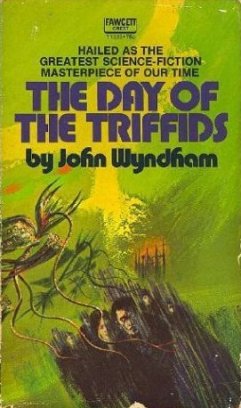
Top 10 Doomer Novels Number 9 – The Day of the Triffids by John Wyndham (1951)


How the World Ends: Mysterious comet passes Earth, leaving nearly all of humanity blinded in its wake.

Scenario: One survivor who retains his sight battles for survival in a world rapidly being overrun with mobile man-eating plants called Triffids.

Coolness Factor: The opening sequence in which the protagonist wakes up in a deserted hospital was chilling reproduced in the movie 28 Days Later and the teevee series, The Walking Dead. British sci-fi at its best--who would have thought that a bunch of plants could be so bad ass.

Likelihood of Scenario Coming True: 0 out of 10. Since there is no such thing as Triffids, I think we can sleep soundly knowing this book, while a great read, is not a prophecy of our collective fate.

Saturday, June 4, 2011

Top 10 Doomer Novels Number 10 – Earth Abides by George R. Stewart (1949)


How the World Ends: Super epidemic wipes out most of humanity leaving only very scattered survivors.

Scenario: Protagonist tries to maintain the memory of civilization as the leader of a post-plague community.

Coolness Factor: Despite being over 60 years old, Earth Abides holds up very well as a work of post-Apocalyptic science fiction. The story begins as a last man alive tale, turning more philosophical once the protagonist begins to assemble a tiny band of survivors scratching out a living among the ruins of San Francisco. As the story progresses the protagonist tries to instill in the youth of the struggling new community the knowledge the old world, only to find that it becomes increasingly irrelevant as time passes.

Likelihood of Scenario Coming True: 3 out of 10. A worldwide pandemic is among the more plausible doom scenarios, and Stewart’s observations of the tribalism that would arise among the survivors is chillingly realistic.