Showing posts with label overpopulation. Show all posts

Friday, October 31, 2014

The Scariest Halloween Story You'll Read Today


(Editorial note: There was a BBC report earlier this week which raised the alarm about world population growth, stating that rather than leveling off at around 9 billion by 2050, as previously postulated by the UN, that the population could instead reach 12 billion by the year 2100. Just prior to the publication of that article, I wrote the post below in which rather than having a team of scientists furiously studying their latest computer algorithms, I just used a simple calculator and a world population counter to come to basically the same conclusion. I've decided not to alter my original post in light of the BBC report, just to show that figuring this stuff out isn't nearly as hard to do as the "experts" would like you to believe it is).

Boo!

As I highlighted at the time here at TDS, on Halloween Day 2011 at exactly 1:48 P.M. the poplation counter site Worldometers estimated that the world had just added its 7,000,000,000th living human. Not to worry, the optimists assured us, birthrates around the globe have been declining since 1960s and it's a well known "fact" that when the wealth of societies increase, women on average start having fewer babies. Some optimists who study these issues have gone as far as to say that world population will level off at around 9,000,000,000 by around the year 2050.

Ahhh...optimists. They are just so much fun to poke with a rhetorical stick. I don't think I'll ever get tired of it.

Let's start by reminding everybody where we have come from. The data shows that it was upon reaching the 3 billion mark in 1959 that human population numbers realy began to spiral out of control. From that level the world raced to 4 billion in 1974 (just 15 years later) and 5 billion in 1987 (just 13 years after that). The last two milestones were each reached in exactly one dozen years, 6 billion in 1999 and 7 billion in 2011. Admittedly, the raw numbers DO indicate a slow down in birth rates, but the sheer size of the the current human population has caused the momentum of increase to lumber steadily forward anyway. Already we are in a situation where I, one of the eldest members of Generation X, have seen the human population of planet Earth double in just my lifetime.

In that spirit, let's have a little check of the Worldometers website again today, three years after the adding of the 7th billion person, and see if we can see any signs of a continuing slowdown in population growth. Hmmm, seems the total now is slightly above 7,270,000,000. That means that for the last three years the AVERAGE annual increase in human beings was 90,000,000. At that rate, the world's 8 billionth person will be born in 2022, just ELEVEN years after the previous milestone was reached. Extrapolate out further, and world population at midcentury will be around 10.5 billion, not the 9 billion the optimists were touting.

So why have the optimists apparently been proven wrong? Well, the one big elephant in the room is the fact that the the world economy for anyone who isn't among the elites has pretty much sucked since the financial crash of 2008. So much for the idea of rising prosperity serving as a gigantic prophylactic.

There has rightly been lots of worry about ebola, but to put the epidemic in perspective right now it would have to kill about 90,000,000 people PER YEAR just to level off the planet's population. So, as if we didn't have enough real world events to scare us this Halloween, here's an oldie but a goody that just continues to make calls from INSIDE THE HOUSE.

Boo.

(2nd editorial note: putting aside for a moment the fact that resource depletion will likely not allow continued human population growth beyond midcentury, if the planet did theoretically have the resources and we did in fact reach 10.5 billion in population by 2050, even the BBC report's "pessimistic" assessment of 12 billion humans in 2100 would likely be well off on the low side)


Bonus: Happy Halloween, everybody


Wednesday, October 31, 2012

Halloween's Scariest Number: 76,000,000


It was one year ago today, perversely on Halloween, that it was officially announced that World Population had broken the 7 billion barrier for the first time. So today I thought I would check back exactly one year later to see how many more people have been added since then. According to Worldometers.info, which calculates population growth based upon world wide census data, the total annual increase in population since last Halloween is around 76 million.

We keep hearing in the media that population growth rates are gradually dropping around the world and that the total numbers will cap off at around 9 billion by midcentury. This seems unlikely, for even if the growth rate does continue to incrementally decline enough to keep the increase in raw numbers fairly stable (around 75 million per year) over the next few decades, the world would see its 8 billionth living human in the year 2026 and its 9 billionth by around 2040. By 2050, we would be closing in on the 10 billion mark. If the growth rate itself stabilizes and stops declining at any point in the next few years, 10 billion by midcentury is virtually assured. Sometimes, mathematics can really be a bitch.

Of course, this hypothetical game of playing with the numbers assumes that there will be sufficient energy, water and food resources to sustain several billion additional people. Given that the signs are already there that we are approaching the limits of the total resources the world can produce on an annual basis, and that furthermore the amount of resources produced annually is very likely to go into decline as soon as this current decade, at some point continued population growth is going to slam headlong into the brick wall of natural limits.

I gather that none of this is likely to be news to anyone who reads this blog regularly. It is just something to contemplate the next time some optimistic media report claims that human population growth is going to be curtailed at a sustainable level at some point in the coming decades.


Bonus: "Cause everyday is Halloween...it's everyday"

Friday, July 27, 2012

"Saving the World" Versus "Saving the Economy"


If it seems like I spend a lot more time on this blog bashing liberals and progressives than I do reactionaries and conservatives, it's because I do. The latter I consider to be a lost cause, while liberals and progressives are supposedly open minded enough to "know better." Sadly, they rarely do, even if most of them have convinced themselves that they do.

This hit home for me again as I was reading a recent news story from USA Today entitled, "Americans put off having babies amid poor economy." Here's an excerpt:
Twenty-somethings who postponed having babies because of the poor economy are still hesitant to jump in to parenthood — an unexpected consequence that has dropped the USA's birthrate to its lowest point in 25 years.

The fertility rate is not expected to rebound for at least two years and could affect birthrates for years to come, according to Demographic Intelligence, a Charlottesville, Va., company that produces quarterly birth forecasts for consumer products and pharmaceutical giants such as Pfizer and Procter & Gamble.

Marketers track fertility trends closely because they affect sales of thousands of products from diapers, cribs and minivans to baby bottles, toys and children's pain relievers.

As the economy tanked, the average number of births per woman fell 12% from a peak of 2.12 in 2007. Demographic Intelligence projects the rate to hit 1.87 this year and 1.86 next year — the lowest since 1987.

The less-educated and Hispanics have experienced the biggest birthrate decline while the share of U.S. births to college-educated, non-Hispanic whites and Asian Americans has grown.

"What that tells you is that births have clearly been affected by the economy," says Sam Sturgeon, president of Demographic Intelligence. "And like any recession, it doesn't hit all people equally, and it hit some people much harder than others."

The effect of this economic slump on birthrates has been more rapid and long-lasting than any downturn since the Great Depression.

"Usually consumer sentiment bounces back a little quicker," Sturgeon says. "People are a bit in a wait-and-see pattern. … There's a sense of hesitancy, of 'What does better look like? How will we know?' — especially for those of prime child-bearing age. … The key word would be uncertainty, a lot of uncertainty. "

Many young adults are unemployed, carrying big student loan debt and often forced to move back in with their parents — factors that may make them think twice about starting a family.

"The more you delay it, the more you delay the possibility of a second or third child," says Stephanie Coontz, director of research and public education at the Council on Contemporary Families. "This is probably a long-term trend that is exacerbated by the recession but also by the general hollowing out of middle-class jobs. There's a growing sense that college is prohibitively expensive, and yet your kids can't make it without a college degree," so many women may decide to have just one child.
I know that I have put my history as a former progressive well behind me because my immediate reaction was that this was the first good news I've heard in quite some time. Overpopulation is one of those issues that every thinking person realizes is a major crisis facing humanity, yet few ever want to discuss in polite company. More to the point, however, is that the raw number of human beings on the planet is only part of the problem. Author Mark Herstgaard, in his book, Earth Odyssey, observed that from a resource consumption standpoint, a child born into an American family will on average during the course of its lifetime consume approximately ten times as many resources and cause about ten times as much environmental destruction as a child born into a third world, subsistence level existence. Ergo, the effect of any decline in population in the U.S. is multiplied by ten times as far as a beneficial effect on the environment compared to the same reduction in poor third world countries.

Therefore, if you are a liberal or progressive who is supposedly concerned about environmental destruction, climate change and resource depletion, you should welcome this news. But no, instead what we get from many of those from my former political tribe, especially those who call themselves economists such as Paul Krugman, is a lot of Keynesian-on-steroids nonsense about how the U.S. should double down on its insane levels of deficit spending in order to jump start our economy.

Assuming for a moment that we are not approaching the natural limits to economic growth, what would a return to a robust economy really look like? That's easy: more mindless consumption, more idiots trampling themselves at Walmart on Thanksgiving evening to save 20% on a loss-leader toaster oven, more SUVs on the road burning precious fossil fuels and expelling carbon into the atmosphere, more exurban McMansions and strip malls blighting the landscape, more garbage, more pollution, more poisons in the water and in the air, more species driven into extinction, and faster consumption of our remaining nonrenewable resources. In short, supporting a return to economic growth while claiming to be concerned about the environment is an insane position. Yet, I'll bet if you were to poll liberals and progressives as to whether they agree with the public policy positions of Bill McKibben and Paul Krugman an overwhelming majority would say yes to both.

My position, which I've stated here many times before, is that our society needs to start powering down voluntarily based upon the idea of shared sacrifice. That means giving up cars in favor of public transportation, giving up the American Dream of a single family home with a white picket fence in the yard, giving up on countless trips to the mall to buy more shit you don't need and giving up on taking a fancy vacations every year while still having money to save for retirement and also send the kids to college. In short, it means lowering the expectations of ever greater material comfort in exchange for a slower, simpler more personally enriching life based upon family, friends and community instead of continually buying the latest electronic gadget or running out like a lemming to the Multipleplex at midnight to see the latest stupid Batman movie.

But feel free to ignore my opinion on this subject because the sad fact is IT AIN'T EVER GONNA HAPPEN. As proof, I offer up the very next sentence from the USA Today article:
"We have to think through our policies," she says. "We've got to provide better support systems for working mothers as well as fathers."
Because we CAN'T POSSIBLY give up on the idea of growing our population, growing our economy and the growing destruction wrought upon the planet's environment. Perish the thought.


Bonus: From my You Tube channel: Sorry, liberals and progressives, but you can't always get what you want, and you probably won't get what you need, either

Monday, May 21, 2012

Peak Fish


Over the weekend, the Washington Post ran the above chart as part of a brief blog post covering the topic of Peak Fish:
Between 1950 and 2006, the WWF report notes, the world’s annual fishing haul more than quadrupled, from 19 million tons to 87 million tons. New technology — from deep-sea trawling to long-lining — has helped the fishing industry harvest areas that were once inaccessible. But the growth of intensive fishing also means that larger and larger swaths of the ocean are in danger of being depleted.

Daniel Pauly, a professor of fisheries at the University of British Columbia, has dubbed this situation “The End of Fish.” He points out that in the past 50 years, the populations of many large commercial fish such as bluefin tuna and cod have utterly collapsed, in some cases shrinking more than 90 percent (see the chart to the right).

Indeed, there’s some evidence that we’ve already hit “peak fish.” World fish production seems to have reached its zenith back in the 1980s, when the global catch was higher than it is today. And, according to one recent study in the journal Science, commercial fish stocks are on pace for total “collapse” by 2048 — meaning that they’ll produce less than 10 percent of their peak catch. On the other hand, many of those fish-depleted areas will be overrun by jellyfish, which is good news for anyone who enjoys a good blob sandwich.

The full WWF report , meanwhile, is chock full of brightly colored graphs charting the decline of wildlife across the globe. All told, global vertebrate populations have declined by some 30 percent since 1970. But that number masks a lot of variation. Wildlife actually appears to be recovering in the temperate areas, while it’s utterly collapsing in the tropics. (It seems there have been some modest conservation successes in the wealthier temperate regions — the European otter is staging an impressive comeback, for instance.)

The big thing the WWF paper emphasizes, however, is that human consumption patterns are currently unsustainable. We’re essentially consuming the equivalent of one and a half Earths each year. This is possible because we borrow from the future, as is the case with fish — one day the world’s fish population may collapse, but there’s plenty for us now. WWF doesn’t quite call it a Ponzi scheme, but that’s the first metaphor that comes to mind.
Wow--a pretty grim assessment. Too bad Professor Pauly had to go soft at the end:
So is there any way to stop this slide? After all, it’s not like people can just stop eating fish altogether. Pauly, surprisingly, is fairly optimistic. He argues that strict government quotas on catches can help stop the slide. “There is no need for an end to fish,” he writes, “or to fishing for that matter.” (He’s not sold on aquaculture, or fish farming, since it often requires huge harvests of smaller fish to feed the big carnivorous ones in farms.)
And yet, the Post, actually gives a pretty realistic rebuttal to Pauly's optimism:
The hitch is that when governments have tried to institute such quotas in the past — as they’ve recently attempted with Atlantic bluefin tuna — the rules tend to get, uh, watered down under intense lobbying. Or else shadowy black sushi markets emerge to flout the rules. But no one said it was easy, halting the end of fish.
Of course, one could reasonably ask why this story was not plastered across the Post's front page as a screaming headline instead of being tucked away on Ezra Klein's Wonkblog (please note that it was NOT Klein who actually posted it), but I guess you have to start somewhere.

Of course, with any story like this, the reader comments can also be enlightening. Like this one:
large23220
5/20/2012 12:56 PM EDT
More lib crap-aganda. God told us to be fruitful, multiply, and take dominion over all the fishes of the sea. God didn't qualify that instruction with any touchy-feeling whale-hugging horse hockey.

There will always be enough fish sticks. God promised.
And Jaysus wept...


Bonus: My all time favorite fishing song.

Wednesday, February 22, 2012

Great Recession Porn: Economic Crisis Slows U.S. Population Growth


As it turns out, a bad U.S. economy is not conducive to robust U.S. population growth. Here is the USA Today with the details:
The U.S. population is growing at the slowest rate since the Great Depression after two decades of robust increases.

For two consecutive years since 2009, the population has grown just 0.7% a year, down from annual increases around 1% in previous years and the lowest since the late 1930s. The U.S. gained 2.2 million people from 2010 to 2011 — fewer than the 2.8 million added a decade earlier — reaching a total of 311.6 million.

"Almost anybody who observes these things over the years can say this is almost all recession-related," says Carl Haub, demographer for the Population Reference Bureau.

The government says the recession ended in June 2009. Although the economy has improved, the downturn's effect on birth and immigration lingers. The number of babies born from July 1, 2010, to July 2011 dropped 200,000 from the same period in 2008-09. The number of additional immigrants fell 150,000.

"It's an indicator of an unhealthy economy," Haub says. "People are obviously still delaying births, and immigration has continued to drop because job opportunities are not there."

The U.S. fertility rate — which has been close to the replacement level of 2.1 children per woman in contrast to many developed nations that are well below that level — now is estimated to have fallen to 1.9, says demographer Joseph Chamie, former director of the United Nations Population Division and more recently research director at the Center for Migration Studies.
Putting aside the looming collapse of our economy for a moment, long term this portends a real disaster for an aging population which expects to be supported by government programs post-retirement. Demographics were already working against the long term solvency of Social Security and Medicare even before the downturn hit.

Though the article doesn't say so, I would gather that a large percentage of those delaying having children are the sons and daughters of the middle class who have not been able to find the types of secure employment that would allow them to settle down and raise a family. Which means the trend is doubly bad because it is the middle class that pays the lion's share of the overall taxes in our society.

Nevertheless, somehow despite this very bad news hope still springs eternal:
Demographers expect population growth to pick up when the economy rebounds fully, but a bounce-back in births is likely to lag.

"Many — but likely not all — of the postponed births can be expected to be made up," Chamie says. "Even with the slight current downturn in births, the U.S. population will very likely reach 400 million midcentury."
There it is again, that completely faith-based belief that real economic growth just HAS to resume, because in always has in the past. The demographers would do us all a much better service if they would instead devote some time studying what the effects would be if economic growth DOESN'T resume. Because that is the reality we all face and the one for which we need to start basing our planning for the future.


Bonus: "I think I'm sophisticated 'cause I'm living my life like a good homosapien. But all around me everybody's multiplying 'till they're walking round like flies, man"

Monday, October 31, 2011

Happy Seven Billion People Day


Disproving once and for all the notion that statisticians do not have a sense of humor, today is not only Halloween but the day, according to the leading entities charged with tracking human population growth, that our collective numbers will exceed the seven billion mark. My preferred source for keeping track of world population is Worldometers.info, which has been morbidly counting down to this momentous event for several weeks now. It looks like the clock will strike seven billion at precisely 1:48 P.M. EDT this afternoon.

To put what this means in perspective, here's a quote from an article written by Paul B. Farrell that appeared on the website MarketWatch back on June 28th:
Yes, you can forget “Peak Oil.” Forget global warming. Forget debt, deficits, defaults. Forget commodities, scarce resource depletion. Forget all other economic, political, military problems. Yes, forget all of them. None of them matter … if our leaders fail to deal with the world’s out-of-control population bomb. Nothing else matters. Nothing.

Still, the silence is defining. We’re trapped in this deafening “conspiracy of silence.” Neutered. Blind to this suicidal path, incapable and unwilling to face the greatest single economic challenge in history. Won’t wake up till it’s too late.

Why? Deep in our hearts we see no acceptable universal solution. So we wait … until this economic bomb stops tick-tick-ticking. Explodes in our faces. Till the wake-up call, a total economic collapse. Till then, the silence is deafening. We stay in denial. Waiting.
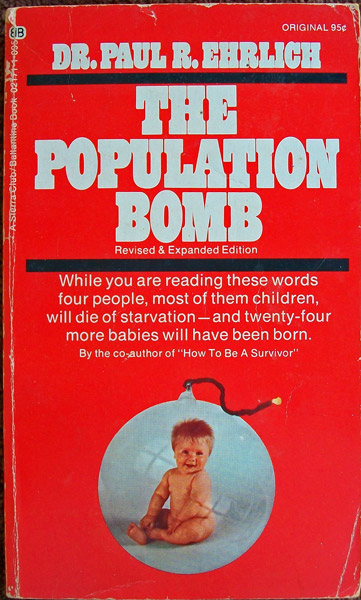
If you want to know why I am such an extreme pessimist you need look no further than the blurb above. Yes, optimists have been making fun of Thomas Malthus for more than two centuries, and have been deriding author Paul Ehrlich of Population Bomb fame for a couple of generations now. But the thing to keep in mind is that Malthus and Ehrlich need only be proven right once, whereas their critics have to keep being right forever and ever lest their criticism blow up in their faces as the bomb finally detonates.

The key question is how long do we have until the bomb does finally explode? No one can say for sure, obviously, and if I didn't think it was imminent--say within the next 20 years or so--I'd probably be off somewhere sipping a beer and a watching football game rather than sitting here writing for this blog.

Prepare yourself accordingly.


Bonus: since this song came out around the same time as The Population Bomb was published, I always thought it would be the perfect theme for the title sequence were they ever to make the book into a feature film.


Double Bonus: a wicked Doug Stanhope rant on overpopulation (warning: NSFW).

Friday, October 14, 2011

U.S. Birth Rate Drops As Economy Falters

Image: Percentage decline in U.S. birth rates by state, 2007-2010
In this morning's post, I reported an anecdote about my friend Leslie, who among other things has bemoaned that her dire financial situation is going to delay her being able to start a family. Well, as reported today by Talking Points Memo, here come the statistics indicating that she is not alone:
A new Pew report details a sharp decline in fertility rates across the United States that appears closely tied to the economic recession that hit the country in approximately 2007.

The correlation between a faltering economy and the national birth rate is nothing new. What is astounding, however, is that the birth rate for almost every state has dropped dramatically. In 2007, the country experienced a record number of births, 4,316,233. Since then, following one of the worst recessions the U.S. has ever seen, Pew's provisional data shows that the number of births in 2010 was just 4,007,000.
Note that the biggest declines have occurred in some of the states that have been hit hardest economically during the Great Recession, such as California, Arizona, Nevada and Florida. Another thing to keep in mind about this is that all of our social welfare programs, particularly Social Security, are designed based upon an assumption of continued population growth. Should it continue long term, this trend spells financial disaster.

I guess we're going to have to start referring to: Peak Americans.

Wednesday, August 17, 2011

Earth: 2050 (10 Reasons Why We’re Doomed)


Sometimes it’s hard to keep the doomer faith in the face of the relentless cheerleading and obfuscation pumped from the mainstream media machine every day at the direction of our corporate overlords. Every time it seems like reality is about to pop the bubble of delusional faith in the system held by the vast majority of Americans, The Powers That Be somehow manage to pull out another magic trick that resets the Hologram and keeps the façade of business as usual firmly in place. Yes folks, the truth is out there, but it’s as lonely as the guy who established the “Drag Queens for Michelle Bachmann” political action committee.

In these times of enforced normalcy, looking beyond the immediate horizon can help one regain one’s bearings. Hard to believe, but the middle of the 21st century is now less than 39 years away. The Beatles broke up longer ago than that. It’s a date well within the expected lifetime of anyone under the age of 40 today. Newborn babies and toddlers will be just approaching middle age. In short, it is a time frame that ought to at least occupy your thoughts at some point, especially if you have children.

The United Nations has predicted that world population will reach nine billion souls by that time; up from the seven billion mark we are on track to pass later this year. From a purely demographic standpoint, this is actually an optimistically low number. If population growth were to continue at the current rate, the number of humans occupying planet Earth will actually top 10 billion by that time.

Unfortunately for anyone of a humanitarian bent, there are a whole host of reasons to believe that even the lower estimate is actually wildly off on the high side and that world population may actually end up being far LESS then than it is today. So many factors are converging to put downward pressure on the current number of approximately 80 million in net population growth every year that it is difficult to keep track of them all.

Internet readers seem to love lists, as they pop up repeatedly on many of the most high traffic sites. So in that spirit, here’s a handy list of 10 current trends that are sure to go from being statistically ominous today to wreaking mass havoc by middle of this current century:

1). Peak Oil - Conventional crude oil production peaked in 2006, and total production including non-conventional sources has only slightly increased since then. Oil producers are pulling out all the stops to increase production where they can, and yet are only barely managing to overcome the depletion of older oil fields. Simply stated, there is no other energy source that can replace oil as far as density and ease of use. By 2050, the world will likely produce only a tiny fraction of what it does currently, with dramatic consequences to our modern industrial civilization.

2). Peak Phosphorous – This one is far less well known but just as serious as Peak Oil. Phosphorous is a key ingredient in the production of fertilizer, without which modern industrial agriculture would not be possible. Phosphorous production is expected to peak by the year 2030 and begin to decline thereafter. Once it does, the world will no longer be able to increase the production of the grains that are vital to feeding many billions of people and once decline sets in, yields will drop accordingly.

3). Peak Fish – Fish stocks in the world’s oceans are already beginning to crash due to overfishing. At current rates, it is expected that the world’s oceans will be nearly devoid of animal life by mid-century just at a time when agricultural production is also plummeting due to Peak Phosphorous.

4). Peak Water – Hundreds of millions of the world’s poor already do not have access to clean drinking water, and supplies are going to be even more strained as populations continue to grow. In the United States, the Ogallala Aquifer that irrigates the Great Plains is depleting rapidly from overuse and could be effectively dry by mid-century, returning the middle of the country to the days of the Dustbowl and rendering a vast swath of irrigated agricultural land utterly useless.

5). Peak Tin (hat tip to Dave Cohen of Decline of the Empire blog) – tin is a key component of all electronic items that are produced. Production of the element is just now reaching its peak at a time when sales of such items have become a vital part of the world’s economy. Take away all that ICrap and world GDP would take a significant hit. Given the disposable nature of manufactured products today, by 2050 most electronic devices will likely have become useless relics.

6). Peak Coal – China’s voracious appetite for coal to feed its booming economy is depleting what was once thought to be a couple of centuries' supply much faster than expected. Like with oil, most of the easy to extract and high quality coal reserves are already gone, increasing the cost over time for every unit of energy mined. Concurrently, increased burning of coal also exacerbates climate change (see below).

7). Peak Infrastructure – The United States alone has tens of thousands of miles of paved highways, many more secondary roads and thousands of bridges. Much of this infrastructure is aging and in need of repair and replacement. The high cost of asphalt (made out of oil) and declining tax revenues are causing a big slowdown in fixing and replacing it. By 2050, the nation’s transportation grid will likely be in an advanced state of decay, eventually making travel as difficult as it was before the age of the automobile.

8). Climate Change – Whether you believe global warming is man made or not, the general scientific consensus is that it is happening and getting worse more rapidly than expected. Droughts, heat waves and more powerful storms such as hurricanes and tornadoes are becoming more frequent and sea levels will rise more rapidly. By mid-century, many low lying coastal areas will likely be inundated, former agricultural areas will be decimated by lack of rain and huge areas of storm-related destruction will likely be left unrepaired because of economic collapse.

9). Nuclear Contamination – Many of the world's 400+ nuclear power plants are rapidly aging and nearing the end of what was originally thought to be their useful life span. In the United States, the decision has already been made to keep them operating far longer than originally intended, greatly increasing the risk of a major accident. Additionally, spent fuel rods are stored in facilities that require a power source to keep them contained. Within the next few decades it seems inevitable that serious accidents and breaches of containment will happen with greater frequency as electric grids break down, covering large swaths of the planet with massive amounts of deadly radiation.

10). Peak Economy – the great financial crash of 2008 was the first major peak oil-induced economic shockwave. The crash was brought on because the previous “prosperity” was purchased through enormous amounts of public and private debt that can only be serviced if the economy continues to grow. The economy can only continue to grow if energy supplies continue to increase. Peak Oil and peak other resources means this cannot happen and that additional and larger economic shockwaves are inevitable before the neoliberal, globalized world economic model collapses in a heap.

Add it all up and it doesn’t portend for a very positive future. In fact, it seems likely that a mass dieoff of the world’s population will be underway by the by the middle of the 21st century. I take no joy in reporting any of this. Obviously, the suffering that results will be of a scale far beyond anything previously seen in human history. I would be positively delighted to be proven wrong about what I’ve written above. But I don’t think I am.

Thursday, June 16, 2011

Trip Report: Bermuda is Doomed, Part 2 (or What I Did on My Summer Vacation)


If you haven’t been fortunate enough to ever go there yourself, Bermuda is an absolutely beautiful little corner of the globe—beautiful, that is, for a place that is completely and utterly doomed. The people are quite friendly (or at least the ones involved in supporting the tourist trade are), the climate is delightful all year round and even though I’m not the world’s biggest beach aficionado, I will say that I have never encountered a finer or more spectacular stretch of sand than the ones on which we found ourselves sunbathing.

I was actually quite intrigued by the history of the place, which is one reason I wanted to go there. The first permanent inhabitants didn’t arrive until 1609, when a British ship that was part of a relief convoy headed to resupply the starving Jamestown colony got blown off course in a storm and was shipwrecked. The enterprising crew built a new vessel and continued on their way (leaving a few hearty souls behind), and when the captain returned to England he convinced the crown that the island chain would make a great naval weigh station.

So Bermuda is actually one of those very rare places settled by Europeans utterly without the taint of colonialism or native genocide. Unfortunately, the British being the British—in other words never ones to allow humanitarian principles stand in the way of making a quick buck—they had to go and mess it all up by introducing slavery to the colony only a few years after its founding.

One thing I learned during a visit to the local history museum I found fascinating is that for many years Bermuda was a leading supplier of vegetables to locales from New York all the way up to Nova Scotia. In the 19th and early 20th centuries, the colony exported tens of thousands of pounds of vegetables every week, which was especially appreciated by their northerly neighbors during the long, cold winter months. Even now, as we rode around the island we could see the legacy of those days—large vegetable plots squeezed into the crowded interior landscape seemingly almost randomly. Vegetables are such a big part of Bermuda’s history that the colloquial nickname for a local person is, I kid you not, an Onion. Thus the name for a charming pub we visited that was founded by two proprietors, one French, the other Bermudan: The Frog and Onion.

Bermuda’s agricultural past simply highlights the very large problem it faces in this era of peak oil and resource depletion. The archipelago, charming as it is, has a current population of over 65,000 squeezed onto just 21 square miles of land. From once having been a huge exporter of vegetables, Bermuda now imports about 80% of its food. Making matters worse, tourism currently constitutes an estimated 28% of the islands’ GDP while international business contributes about 60% of its economic output (according to Wikipedia).

You can see where I’m going with this. Bermuda is a vastly overcrowded place, totally dependent on food imports with an economy that is utterly dependent on cheap energy. When tourists like me stop going there to spend their excess dollars, and the international firms that rely upon cheap oil-fueled globalization to conduct their business collapse, Bermuda is in deep trouble. And that doesn’t even take into account rising sea levels from climate change and the accelerating worldwide depletion of fish stocks.

Already, cracks are appearing in the façade of Bermuda’s prosperity. They obviously don’t like to advertise the fact but crime, once nearly not existent, has been on the rise in recent years. In several shop windows around the capital city of Hamilton we noted posters supporting something called Bermudians for Non-Violence—which made me wonder exactly who the Bermudians in favor of violence were.

Bermuda also experienced a housing boom similar to America’s, with the average price of a house soaring to an incredible $1.6 million in 2006. Prices are said to have dropped significantly since then, but there are no reliable current figures. How far are those prices likely to drop when the there is no longer any cheap aviation fuel available to power the airliners that bring the tourists, nor any cheap diesel fuel to power the cruise and cargo ships?

All in all, it was lovely trip, and one I am very glad to have had the opportunity to make while it is still possible. But as with so many other things after one becomes aware of Peak Oil, it was difficult to completely put aside thoughts of doom even as I enjoyed this one particular moment in the twilight of the cheap energy era.